Four Holiday 2026 Forecasts Count AI Shopping Four Different Ways. Here Is What Each One Measures.
Adobe, NRF, Salesforce and Shopify have all published holiday numbers. $1.013 trillion, $275.1 billion, AI traffic up 130%, 20% of traffic from AI agents. We lined them up by definition so a Shopify store knows which one describes it.

Product Gale Team
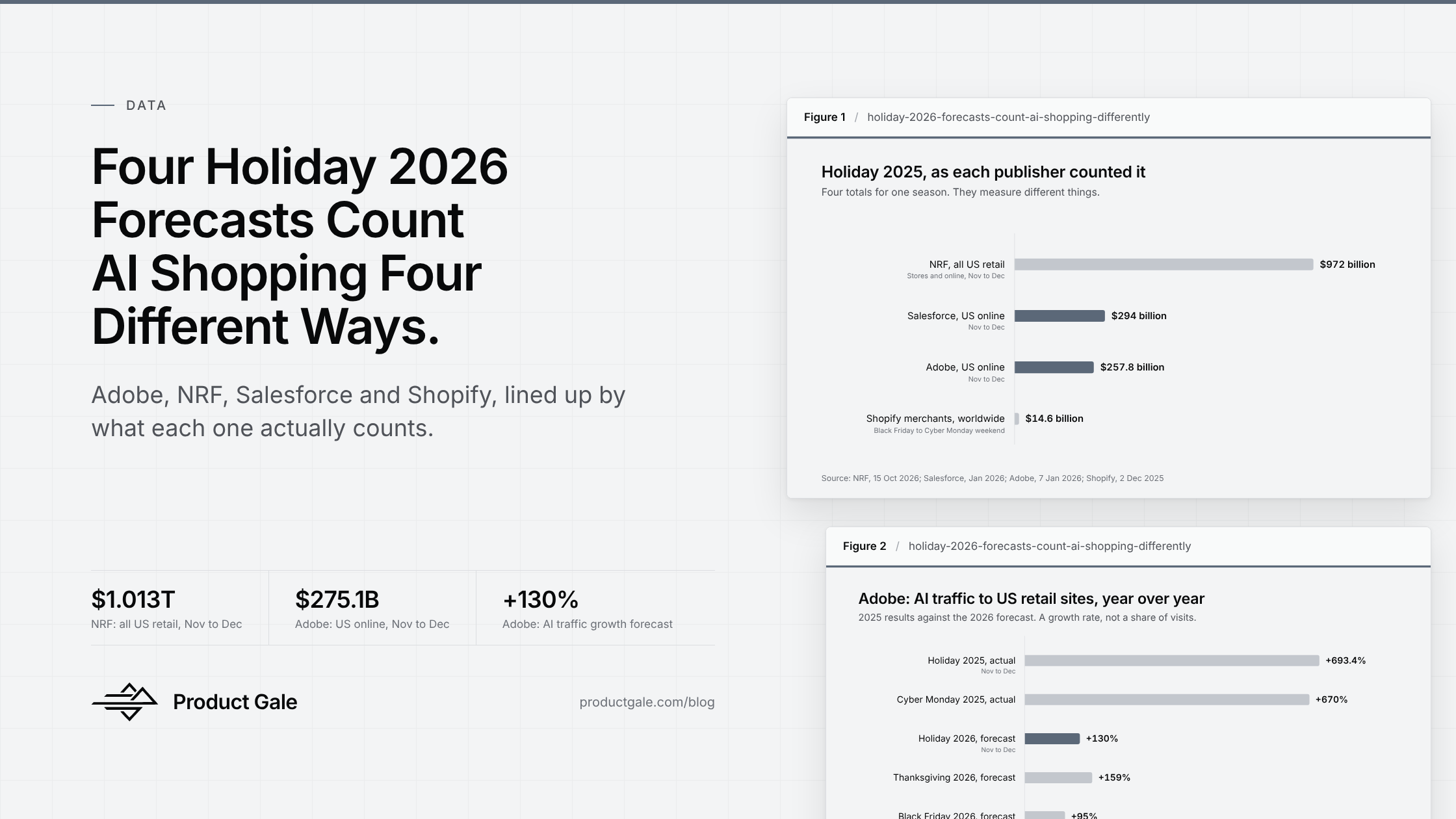
"$1.013 trillion." "$275.1 billion online." "AI traffic up 130%." "20% of holiday ecommerce traffic will come from AI chat agents." Every one of those lines comes from a forecast published for the 2026 holiday season, and every one will be quoted next to the others between now and January as if they described the same thing. They do not.
This is the first holiday season in which every eligible Shopify store selling to US customers is in ChatGPT by default, because Shopify switched Agentic Storefronts on by default in March, a change we covered in October. So a merchant will fairly ask how much of the holiday will come through an assistant. The forecasts do not answer that, and some are not trying to.
We pulled the forecasts and the prior-season results from Adobe, the National Retail Federation, Salesforce and Shopify, read each one's own definition of what it counts, and put them side by side.
1. The dollar forecasts do not describe the same economy
Start with the two headline dollar figures. Salesforce's predictions carry no dollar total, and Shopify publishes no forecast at all.
| Forecast, holiday 2026 | Total | Growth | What it counts | Source, date |
|---|---|---|---|---|
| NRF | $1.013 trillion | +4.2% | All US retail in November and December, stores and online, excluding automobile dealers, gasoline stations and restaurants | NRF, 15 Oct 2026 |
| Adobe | $275.1 billion | +6.7% | US online spend, 1 Nov to 31 Dec, on retail sites | Adobe, 28 Sep 2026 |
NRF's number is a retail number. It includes the shopper who walks into a store, and it says nothing about AI at all; the release does not mention it. Adobe's number is an online number, built from what Adobe describes as more than 1 trillion visits to US retail sites, 100 million SKUs and 18 product categories. Neither is a forecast of AI shopping. Both will be quoted in articles about it.
The same split shows in last season's results. Here is holiday 2025 as each publisher counted it.
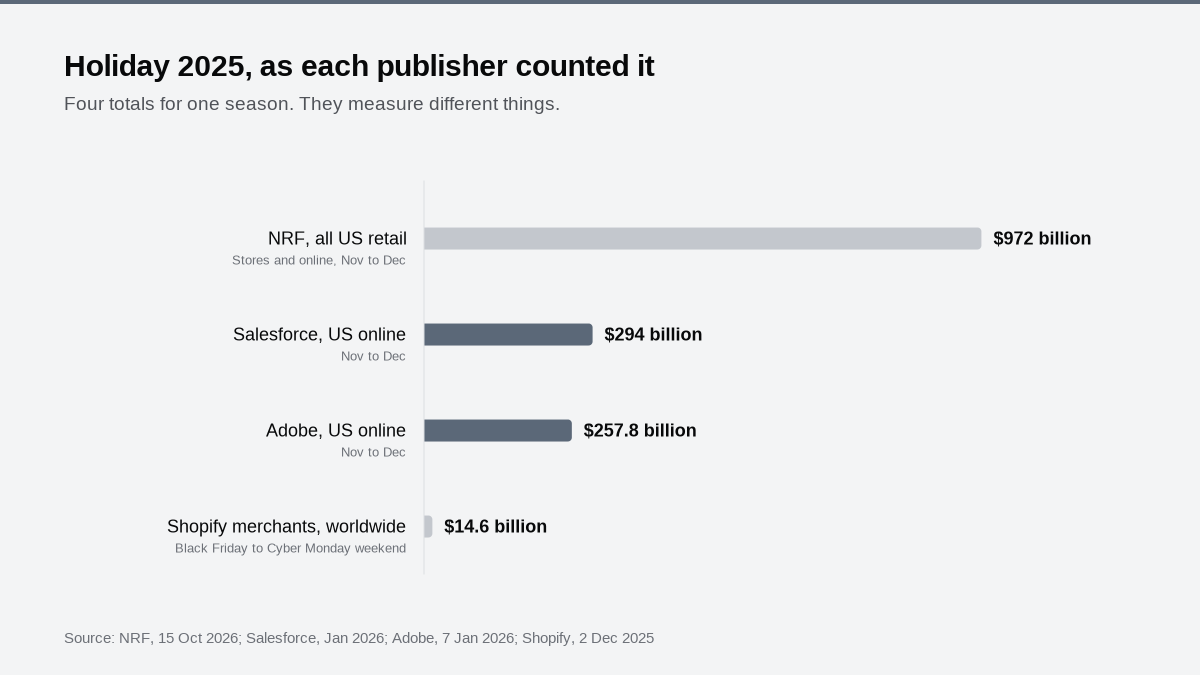
| Holiday 2025 result | Total | Growth | Scope | Source, date |
|---|---|---|---|---|
| NRF | $972 billion | +3.1% | All US retail, Nov to Dec | NRF, 15 Oct 2026 |
| Salesforce | $294 billion | +4% | US online, Nov to Dec | Salesforce, Jan 2026 |
| Adobe | $257.8 billion | +6.8% | US online, Nov to Dec | Adobe, 7 Jan 2026 |
| Shopify | $14.6 billion | +27%, 24% at constant currency | Shopify merchants worldwide, Black Friday to Cyber Monday weekend | Shopify, 2 Dec 2025 |
A caution on the NRF row, because it is the one people use as a yardstick. NRF's 2026 forecast of +4.2% sits against a 2025 result of +3.1%, and NRF's chief economist says "inflation, rising gas prices and pressure on household spending will affect consumers differently across income groups." The release does not say how much of the 4.2% is price. A forecast from any of these publishers is a model of the season, not a measurement of it.
2. Two vendors measured the same online season and disagreed
This is the comparison almost nobody makes. Salesforce and Adobe both report US online holiday sales for 1 November to 31 December 2025. They are not the same number.
| US online, holiday 2025 | Total | Growth | Basis | Source |
|---|---|---|---|---|
| Salesforce | $294 billion | +4% | Activity of more than 1.5 billion global shoppers across more than 89 countries, extrapolated to the broader industry | Salesforce, Jan 2026 |
| Adobe | $257.8 billion | +6.8% | More than 1 trillion visits to US retail sites | Adobe, 7 Jan 2026 |
Salesforce's US total is the larger of the two, and its growth rate is the smaller. Salesforce says plainly that its figures blend first-party and third-party data with "several market assumptions" and that "several factors are applied to extrapolate macroeconomic figures for the broader retail industry." Adobe's figure is drawn from the retail sites it measures. They are two models of one season, built from different samples.
If an article in January says online sales "grew 4%" or "grew 6.8%", the difference is the source, not the season. Compare your store against one publisher's series, never a mix.
3. "Up 130%" is a growth rate, on a base that grew 693.4%
The AI figure most likely to be quoted this season is Adobe's. Adobe expects AI traffic to US retail sites to rise 130% year over year over the holiday, with the biggest rise on Thanksgiving.
| Adobe AI traffic to US retail sites, YoY | Holiday 2025, actual | Holiday 2026, forecast |
|---|---|---|
| Full season, Nov to Dec | +693.4% | +130% |
| Thanksgiving | not reported | +159% |
| Black Friday | not reported | +95% |
| Cyber Monday | +670% | +88% |
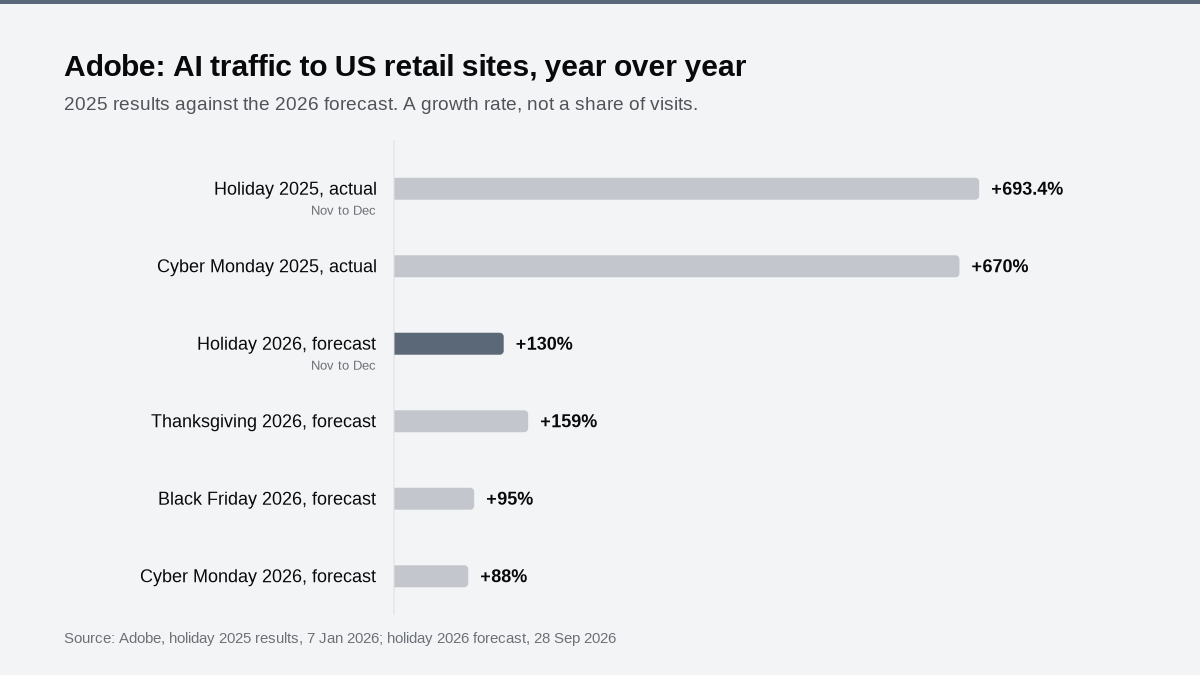
The misreading writes itself: 693.4% last year, 130% this year, so AI shopping is slowing. That reads a growth rate as if it were a volume. The 130% is growth on top of a 2025 season that was itself up 693.4% on 2024. Any positive growth on that base means more AI visits than last year, not fewer.
What Adobe's forecast does not say is just as important. It is a growth rate, not a share. Adobe does not state what fraction of retail visits came from AI in 2025 or will in 2026, so "up 130%" cannot be turned into "AI is X% of holiday traffic" from this release. It also counts what Adobe sees across the retail sites in its own data, which is not the same thing as a 300-product Shopify store.
4. "20% of traffic" and "$262 billion" are influence numbers
Salesforce's figures are the boldest, and they need the most care.
| Salesforce figure | What it says | Period | Source |
|---|---|---|---|
| 20% | of all 2026 holiday ecommerce traffic "will originate from AI chat agents" | Holiday 2026, prediction | Salesforce, 20 Jul 2026 |
| $262 billion, 20% of retail sales | AI and agents "driving 20% of all retail sales and fueling $262 billion in revenue" | Holiday 2025, global | Salesforce, Jan 2026 |
| 1 in 3 | ecommerce sites with "a personal, site-specific shopper agent live by Cyber Week 2026" | Prediction | Salesforce, 20 Jul 2026 |
| 6.2% vs 3.9% | sales growth for brands with shopper agents versus without, 2025 | Holiday 2025 | Salesforce, 20 Jul 2026 |
The $262 billion is the number most likely to be misquoted this season, and it is worth being exact about what it is. It is global, not US. It covers sales that Salesforce attributes to "personalized recommendations and deeper customer engagement" from AI and agents, which can include a retailer's own on-site recommendations, not only a shopper arriving from ChatGPT. And the release does not define how a sale is judged to be driven by AI. It is a modelled influence figure. It is not a count of orders placed through an assistant, and it does not describe what share of a small store's revenue came from one.
The 20% traffic prediction has the same shape. It is a forecast of traffic, not orders, and the post does not say that "AI chat agents" means only the shopper who clicks a link in a ChatGPT answer.
The shopper surveys show how much the answer depends on the question.
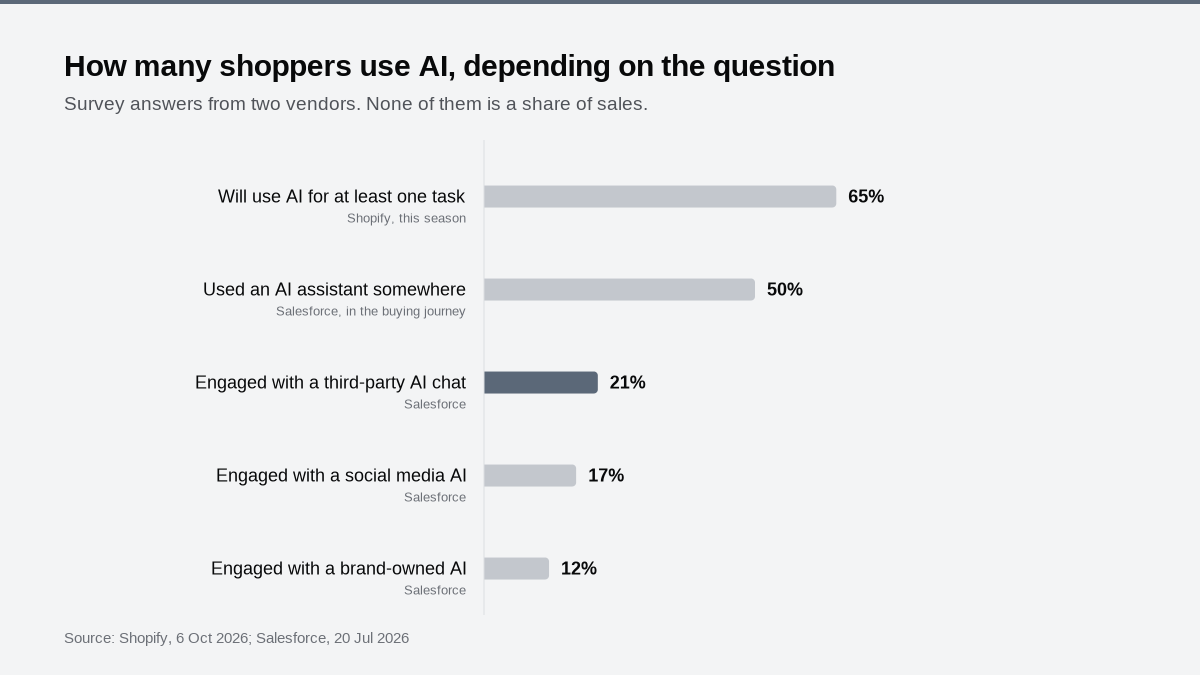
| Survey question | Share of shoppers | Source |
|---|---|---|
| Will use AI for at least one shopping task this season | 65% | Shopify, 6 Oct 2026 |
| Use an AI assistant at some point in the buying journey | 50% | Salesforce, 20 Jul 2026 |
| Engaged with a third-party AI chat assistant | 21% | Salesforce, 20 Jul 2026 |
| Engaged with a social media AI assistant | 17% | Salesforce, 20 Jul 2026 |
| Engaged with a brand-owned AI assistant | 12% | Salesforce, 20 Jul 2026 |
Shopify's own holiday post adds the counterweight: only one third of shoppers said they had trusted an AI agent to buy on their behalf. Salesforce reports that consumer reliance on AI assistants as the first stop in the shopping journey grew 200% in one year. Both can be true: shoppers ask assistants first and still click through to buy.
The row that matters most for a Shopify store is the third-party chat assistant, because that is where Agentic Storefronts put its products. It is also one of the smaller numbers in the table.
5. What Shopify's own number will and will not tell you
Shopify publishes its merchants' Black Friday to Cyber Monday total within days of the weekend, and it will be the first hard number of the season. Here is what last year's release contained.
| Shopify BFCM 2025 | Figure | Source |
|---|---|---|
| Merchant sales over the weekend | $14.6 billion, +27%, 24% at constant currency | Shopify, 2 Dec 2025 |
| Merchants with their highest-selling day ever | more than 94,900 | Shopify, 2 Dec 2025 |
| Average cart | $114.70 | Shopify, 2 Dec 2025 |
Two cautions for this year's version. First, it is a platform total: it rises when merchants join Shopify as well as when stores sell more, so +27% says nothing about a typical store. Second, last year's release did not mention AI, agents or ChatGPT anywhere in its body. Shopify's October 2026 post calls this "the first holiday season of the agentic era" and says Shopify Catalog "structures a merchant's product data so agents can read it" while Agentic Storefronts "put those products in front of shoppers in AI channels like ChatGPT, Google, and Muse." Whether this year's release breaks out AI orders is the thing to watch. If it does not, no published source will tell a merchant how much of their weekend came through an assistant.
What to measure between Black Friday and Cyber Monday
None of the forecasts describes one store. The only number that does is the one you record yourself.
- Pick one baseline and keep it. Take the same days last year, Thanksgiving to Cyber Monday, from your own analytics, and compare against that. Do not compare your store against Adobe one week and Salesforce the next; as section 2 shows, they disagree about the same season.
- Count AI referrers as their own channel. Filter for chatgpt.com, perplexity.ai, gemini.google.com, copilot.microsoft.com and claude.ai, and write down sessions, orders and revenue for each day of the weekend. Adobe's day by day forecasts (Thanksgiving +159%, Black Friday +95%, Cyber Monday +88%) give you something to set your own growth against, with the caveat that they describe large retail sites.
- See what the assistant says before the weekend. A referral only happens if the assistant recommended you in the first place, and that decision leaves no trace in your analytics. Product Gale's scan shows what an assistant currently reads and says about your product pages, and where its journey stops; you can see one on a sample store before deciding to run it on your own.
- Write it down in January. Adobe and Salesforce both published their 2025 results in early January 2026. When the 2026 versions arrive, read the definition first, then the number, and put your own figure beside it.
Sources
- Adobe, US holiday shopping season to hit record $275.1 billion online, forecast, 28 Sep 2026: news.adobe.com
- Adobe, holiday shopping season drove a record $257.8 billion online, 7 Jan 2026: news.adobe.com
- National Retail Federation, NRF forecasts 2026 holiday sales growth as consumers remain resilient, 15 Oct 2026: nrf.com
- Salesforce, 2026 holiday retail predictions, 20 Jul 2026: salesforce.com; 2025 holiday shopping data, AI and agents account for $262 billion of 2025 holiday spend, January 2026: salesforce.com
- Shopify, Shopify merchants generate record-breaking $14.6 billion in Black Friday Cyber Monday sales, 2 Dec 2025: shopify.com; Welcome to the first holiday season of the agentic era, 6 Oct 2026: shopify.com
Keep reading
Coffee Is Bought on Repeat. ChatGPT's Product Feed Has No Field for a Subscription.
The National Coffee Association says 66% of US adults drank coffee yesterday and 82% of them made it at home. Recurly says pause usage rose 337%. Shopify Catalog excludes subscriptions as add-ons, and OpenAI's feed schema carries one regular price per variant.
Supplements in AI Answers: Chatbots Did Worst on Nutrition. The FTC Still Judges Your Page.
CRN says 75% of US adults take supplements. A BMJ Open audit found 49.6% of chatbot health answers problematic, with nutrition the weakest topic. Product.ai found 24.9% of AI shoppers did not know an assistant can repeat brand marketing as fact. The FTC rules sit beside them.
What are AI shoppers costing your store?
Paste your store address and the free scan starts right away. Nothing to install.
Prefer our reporting in Google
Add Product Gale as a preferred source and our posts are marked as preferred for you in Top Stories, AI Mode and AI Overviews.