Coffee Is Bought on Repeat. ChatGPT's Product Feed Has No Field for a Subscription.
The National Coffee Association says 66% of US adults drank coffee yesterday and 82% of them made it at home. Recurly says pause usage rose 337%. Shopify Catalog excludes subscriptions as add-ons, and OpenAI's feed schema carries one regular price per variant.

Product Gale Team
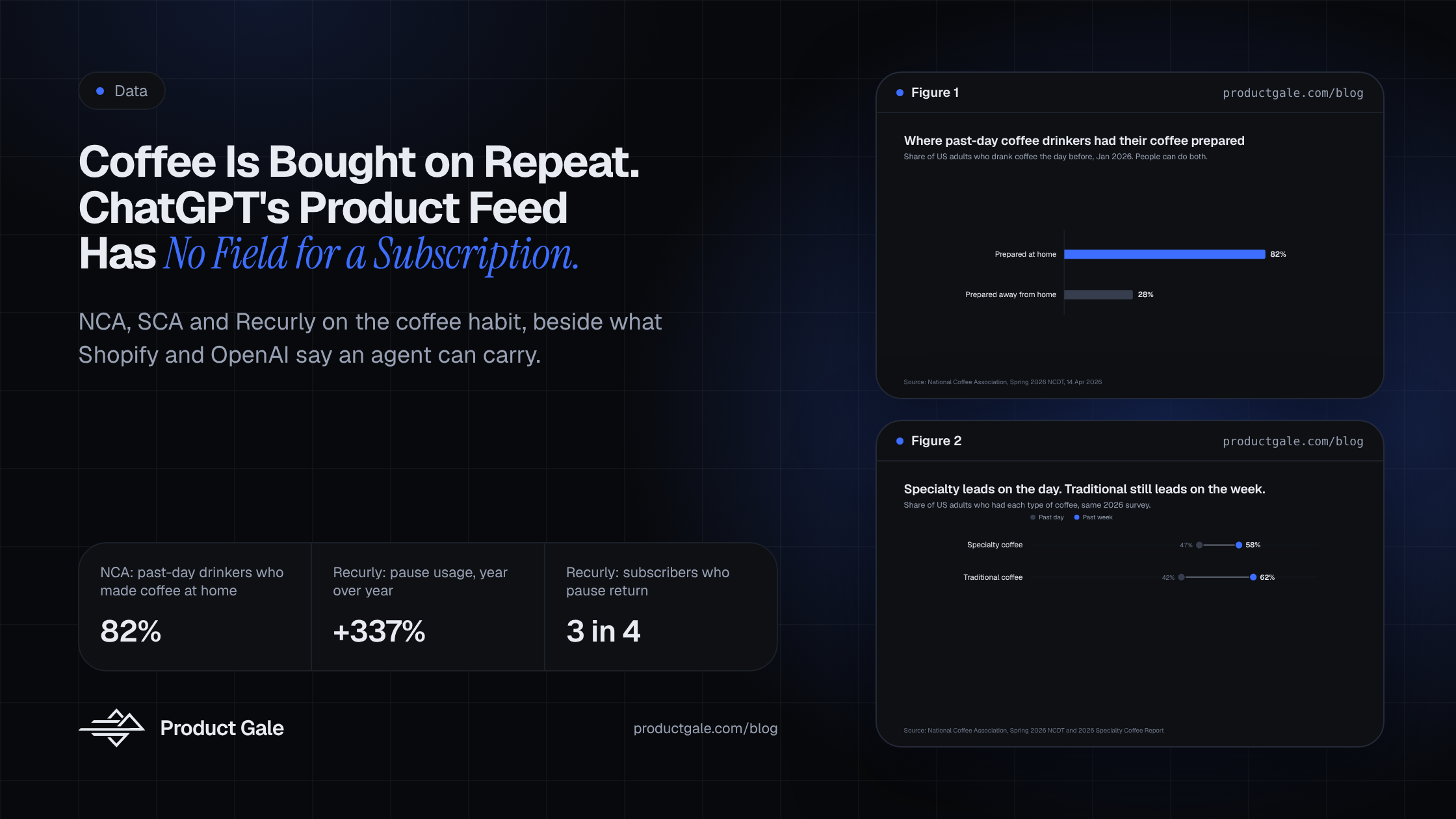
"47% of American adults had specialty coffee in the past day," the National Coffee Association said of its 2026 Specialty Coffee Report, "keeping past-day specialty coffee consumption again higher than past-day traditional coffee consumption." It is true on the day. On the week, in the same survey, it is not. A roaster deciding what to sell online needs both numbers, and the second one is the habit a subscription is built on.
Coffee is the clearest case of a repeat purchase in ecommerce. A bag runs out on a schedule, so a direct to consumer roaster sells it twice: once as a bag, and once as a plan that ships the bag every few weeks, with a skip, a pause and a new grind when the shopper buys a new grinder. An AI assistant that recommends the bag has to understand which of the two it is selling.
We read the National Coffee Association's two 2026 releases on how Americans drink coffee, the Specialty Coffee Association's release of the same specialty data, and Recurly's 2026 State of Subscriptions. Then we read what the agent channels themselves publish about subscriptions: Shopify's help center for Agentic Storefronts and Shopify Catalog, OpenAI's commerce documentation, and Shopify's description of the Universal Commerce Protocol.
1. Coffee is a daily habit, and most of it is made at home
The NCA's Spring 2026 National Coffee Data Trends report, released on 14 April 2026, surveyed a nationally representative sample of 1,850 US adults from 5 to 20 January 2026. It found that nearly 195 million American adults drink coffee each week.
| Measure | Share | Base | Source, period |
|---|---|---|---|
| Had coffee in the past day | 66% | US adults | NCA, Jan 2026 |
| Had coffee in the past week | 73% | US adults | NCA, Jan 2026 |
| Had coffee prepared at home | 82% | Past-day coffee drinkers | NCA, Jan 2026 |
| Had coffee prepared away from home | 28% | Past-day coffee drinkers | NCA, Jan 2026 |
| Had coffee first thing in the morning | 86% | Past-day coffee drinkers | NCA, Jan 2026 |
A caution on the two preparation rows, because they are easy to misread as a split. They add up to more than 100% because the base is people, not cups: a drinker who made coffee at home and bought one on the way to work is counted in both. The 82% is not a share of coffee spending, and the NCA does not say how much of that home coffee was bought online, by subscription, or in a supermarket.
What the rows do say is where the bag goes. Four in five people who drank coffee yesterday made at least some of it in their own kitchen, and 86% had it first thing in the morning. The NCA adds that the time of day and the place of preparation are largely unchanged since 2022. That is the stable, scheduled demand a subscription sells against.
2. Specialty leads on the day, traditional still leads on the week
The 2026 Specialty Coffee Report, released by the NCA in collaboration with the Specialty Coffee Association, uses the same January 2026 survey. The SCA published its release on 27 July 2026.
| Measure | Specialty | Traditional | Source, period |
|---|---|---|---|
| US adults, past day | 47% | 42% | NCA and SCA, Jan 2026 |
| US adults, past week | 58% | 62% | NCA, Jan 2026 |
| Past-day drinkers with coffee prepared away from home | 36% | 23% | NCA and SCA, Jan 2026 |
This is the misreading we opened with. The headline is a past-day comparison, and on that window specialty wins, 47% to 42%. The Spring report's own past-week figures, from the same fieldwork, run the other way: 62% of adults had traditional coffee in the past week, against 58% for specialty. Both are true. More adults had specialty coffee yesterday; more adults had traditional coffee at some point in the week.
The definition matters too. The NCDT counts as specialty any espresso-based drink such as a latte or cappuccino, non-espresso drinks such as cold brew, nitro and frozen blends, and traditional coffee that the drinker perceives as brewed from premium beans or grounds. Some of that is a bag sold online. Much of it is a drink bought at a counter: 36% of past-day specialty drinkers had coffee made outside the home, against 23% of traditional drinkers. The NCA reports that the rise in specialty since 2022 is driven by espresso-based drinks, with past-week latte consumption up from 17% to 21% and espresso from 16% to 20%.
Two figures from the specialty release point at who a roaster's online shop is for. 69% of adults aged 25 to 39 had specialty coffee in the past week, the most of any age group. And 35% of past-day specialty drinkers say flavor is part of what makes a cup specialty, with chocolate, caramel and brown sugar, and vanilla the most popular flavors. Those are the attributes a shopper puts into a question to an assistant: a roast that tastes of chocolate, a decaf for the evening, a grind for a moka pot.
3. Subscriptions keep a customer by letting them pause
No source we could read this run publishes the share of coffee sold by subscription. Recharge, the subscription platform, publishes a 2026 subscription trend report, but its page did not load for us, so no figure from it appears here. Recurly's 2026 State of Subscriptions, released in January 2026, covers 76 million unique subscribers at 2,200 merchants across industries, and it is the best public read on how subscribers behave.
| Finding | Figure | Source, period |
|---|---|---|
| Consumers who cancelled at least one subscription in the past year for lack of use | 52% | Recurly, 2026 report |
| Year over year rise in pause usage at merchants offering pause before cancel | 337% | Recurly, 2026 report |
| Subscribers who pause and eventually return | 3 out of 4 | Recurly, 2026 report |
| New sign-ups that come from former subscribers, all industries | Nearly 1 in 4 | Recurly, 2026 report |
| New ecommerce sign-ups that come from a returning customer | 1 in 7 | Recurly, 2026 ecommerce report |
| Consumers comfortable with AI managing their subscriptions | 43% | Recurly, 2026 report |
A caution on the win-back figure, because it is the one Recurly leads with. "Nearly 1 in 4" new sign-ups from former subscribers is an all-industry number, not an ecommerce one. Recurly's own ecommerce edition says something different about ecommerce: only 1 in 7 new ecommerce sign-ups is a returning customer. A coffee brand should plan on the second number, not the first.
The pause figures are the ones that describe coffee. Lack of use, the reason 52% of consumers gave for cancelling at least one subscription, is the reason a coffee subscriber has when a bag is still half full. A skip or a pause answers it, and Recurly's data says three in four of the people who pause come back. That is why a coffee subscription is not one product. It is a price, a frequency, a discount, a skip, a pause and a cancellation path, and the shopper's decision is about all of them.
A caution on the 43% row. It measures comfort with AI managing subscriptions, in a consumer survey, not a count of anyone letting an AI do it today.
4. What the agent channels say they can carry
Since March 2026, Shopify has made products from its merchants discoverable in ChatGPT by default through Agentic Storefronts and Shopify Catalog. We read the current documentation of each channel for the word subscription.
| Channel or spec | What it says about subscriptions | Source |
|---|---|---|
| Shopify Catalog | Product add-ons are a category not allowed in the Catalog, and the list names subscriptions among them, next to warranties and shipping insurance | Shopify Help Center |
| ChatGPT through Shopify | With agentic checkout on, the agent "can complete some purchases"; purchases not completed in the chat are paid on the store's full checkout in an in-app browser | Shopify Help Center |
| OpenAI product feed schema | One row per purchasable item or variant, a required regular price and an optional sale_price that must be lower; no subscription, frequency or plan field | OpenAI developer docs |
| ChatGPT Wallet | Can be used for a subscription "if your existing checkout supports recurring billing", with the customer's consent | OpenAI developer docs |
| Universal Commerce Protocol | Shopify lists subscriptions among what UCP supports; its engineering post lists subscription schedules among fulfillment shapes the common extension will not all cover | Shopify |
Read together, the picture is narrower than "subscriptions work in AI shopping" and wider than "they do not".
Discovery is where the gap is plainest. A store that sends OpenAI its own feed has one regular price and one sale price per variant to describe a bag of coffee. A subscribe and save price is not a sale: it is a different price under a condition. The schema has nowhere to say that the bag ships every two weeks for less, or that the plan can be paused. On the Shopify side, the Catalog's exclusion is written for add-ons sold as their own product. The help page does not say how a one-time bag that also carries a subscription option is presented, and we would not guess.
Checkout is where the merchant's own system comes back. When the purchase completes on the store's own checkout inside ChatGPT's browser, the merchant's subscription setup is there, because it is the merchant's checkout. When an agent completes it through a protocol, the agent and the store negotiate what each supports. Shopify's engineering post on UCP is explicit about the fallback: when the merchant requires something the agent cannot provide, "the agent fills what it can; the buyer completes the rest."
For a roaster, that is a specific risk. An assistant that knows only the one-time price can recommend the bag at the higher price and never mention the plan, or describe a discount it cannot see the terms of. Neither shows up in a store's analytics as a lost subscriber. It shows up as a one-time order, or as nothing.
What to check on your own store
None of these figures describes your store. Look at your subscription the way an assistant reads it.
- Write the plan in the page's own text. State the subscription price, the frequencies offered, the discount, and that a subscriber can skip, pause or cancel, in plain sentences on the product page. A plan that exists only inside a subscription app's widget may not be in the text a machine reads.
- Check what your feed says. If you send a product feed to an AI channel, look at the price it carries for each bag and grind. OpenAI's schema carries a regular price and a sale price, so decide which one you want an assistant to quote, and keep the subscription terms on the page it links to.
- Ask the questions your subscribers ask. Ask an assistant for a chocolatey medium roast delivered every two weeks, whether your plan can be paused, and what a subscription costs, then read the answer against your page. Product Gale's scan shows what an assistant currently reads and says about your product pages, and where its journey stops; you can see one on a sample store before running it on your own.
- Follow the order to your checkout. Buy one bag on subscription through an AI channel yourself, from the first question to the confirmation, and note the step where the plan is chosen. If the plan only appears on your own checkout, that is the page that has to say everything.
Sources
- National Coffee Association, Spring 2026 National Coffee Data Trends release, 14 Apr 2026: ncausa.org; 2026 Specialty Coffee Report release: ncausa.org; report page: ncausa.org
- Specialty Coffee Association, release of the 2026 National Coffee Data Trends Specialty Coffee Report, 27 Jul 2026: sca.coffee
- Recurly, 2026 State of Subscriptions, Jan 2026: recurly.com; 2026 State of Subscriptions, Ecommerce: recurly.com
- Shopify, Agentic Storefronts announcement, 24 Mar 2026: shopify.com; Help Center, selling on ChatGPT, read 28 Nov 2026: help.shopify.com; Help Center, requirements for Shopify Catalog, read 28 Nov 2026: help.shopify.com; Universal Commerce Protocol: shopify.com; Shopify Engineering on UCP: shopify.engineering
- OpenAI, commerce documentation, product feed schema and accepting payments, read 28 Nov 2026: developers.openai.com; developers.openai.com
Keep reading
Every Shopify Store Is in ChatGPT by Default. The Numbers Say the Sale Still Happens on Your Site.
Shopify switched Agentic Storefronts on for millions of merchants in March 2026, the same week OpenAI wound down Instant Checkout. The published figures from Shopify, Walmart, Etsy, Google and Gartner all point the same way: assistants discover, stores convert.
Supplements in AI Answers: Chatbots Did Worst on Nutrition. The FTC Still Judges Your Page.
CRN says 75% of US adults take supplements. A BMJ Open audit found 49.6% of chatbot health answers problematic, with nutrition the weakest topic. Product.ai found 24.9% of AI shoppers did not know an assistant can repeat brand marketing as fact. The FTC rules sit beside them.
What are AI shoppers costing your store?
Paste your store address and the free scan starts right away. Nothing to install.
Prefer our reporting in Google
Add Product Gale as a preferred source and our posts are marked as preferred for you in Top Stories, AI Mode and AI Overviews.