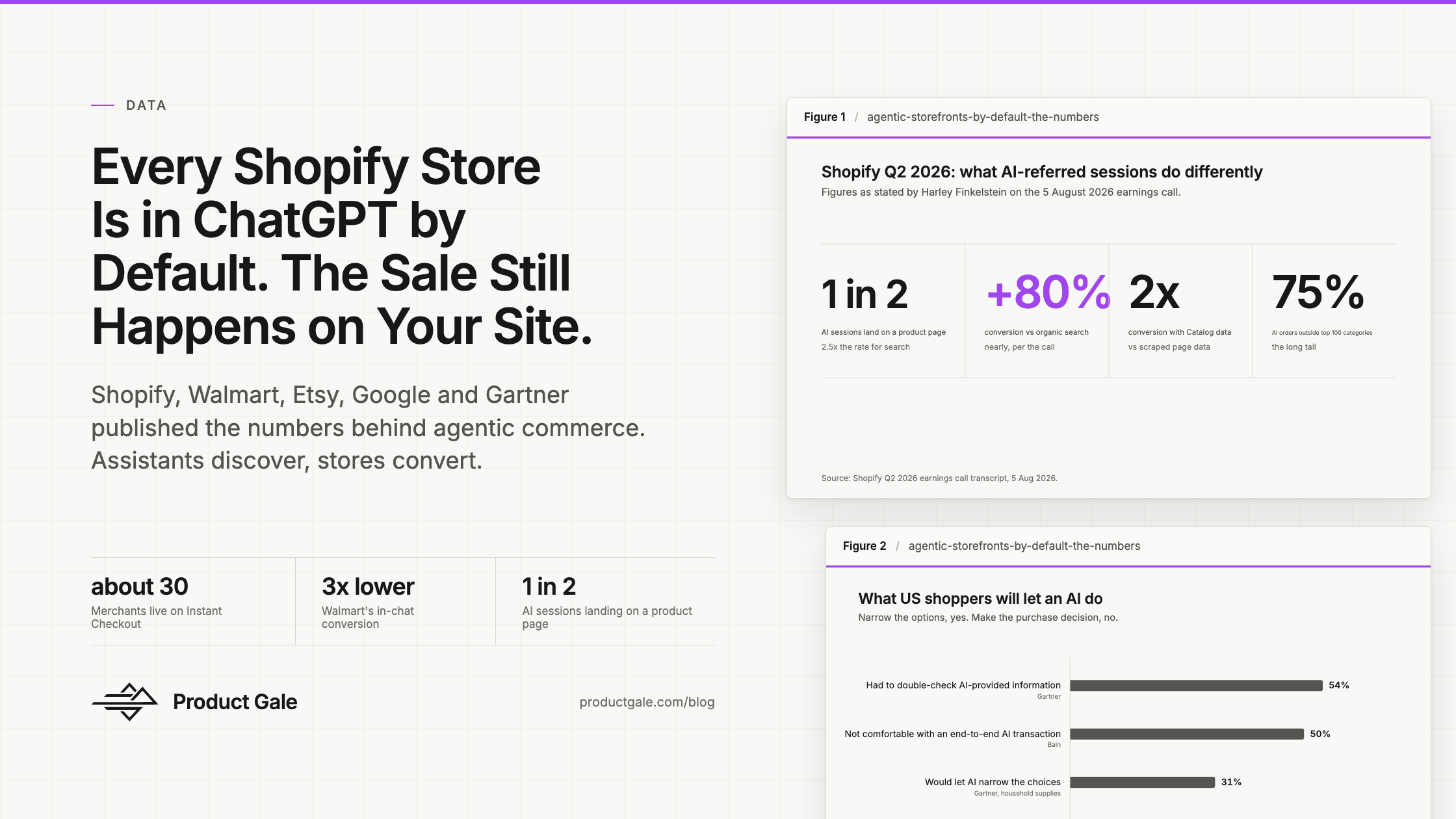
Every Shopify Store Is in ChatGPT by Default. The Numbers Say the Sale Still Happens on Your Site.
Shopify switched Agentic Storefronts on for millions of merchants in March 2026, the same week OpenAI wound down Instant Checkout. The published figures from Shopify, Walmart, Etsy, Google and Gartner all point the same way: assistants discover, stores convert.
Product Gale Team
Every Shopify Store Is in ChatGPT by Default. The Numbers Say the Sale Still Happens on Your Site.
Two announcements landed in the same week of March 2026 and most coverage treated them as unrelated.
On 24 March Shopify said that "millions of merchants can sell to ChatGPT users via Agentic Storefronts," on by default for every eligible store selling to US customers, with no fees. The same day OpenAI said that "the initial version of Instant Checkout did not offer the level of flexibility that we aspire to provide," and moved ChatGPT shopping to a model where discovery happens in the assistant and the purchase happens on the merchant's own checkout.
Read together, they describe one decision. The in-chat purchase was tried at scale by the largest retailers in the world, measured, and retired. What survived is the referral. Here is every published number behind that, and what it means for a store that woke up one morning listed in ChatGPT.
1. Instant Checkout: promised, live, and measured
| Milestone | Figure | Source |
|---|---|---|
| Shopify merchants promised at launch, 29 Sep 2025 | "over a million" | OpenAI launch coverage |
| Shopify merchants live, early Mar 2026 | about a dozen (The Information), "closer to 30" (Shopify to Forrester) | Forrester, 7 Mar 2026 |
| Fee on in-chat sales | 4% to OpenAI, on top of processing | The Information, Jan 2026 |
| Walmart products offered in-chat | about 200,000 | Modern Retail, Mar 2026 |
| Walmart in-chat conversion vs click-out to walmart.com | three times lower | Wired via Modern Retail, Mar 2026 |
| Etsy agentic traffic, Q4 2025 | 15x year over year, under 1% of total | Etsy Q4 call, 19 Feb 2026 |
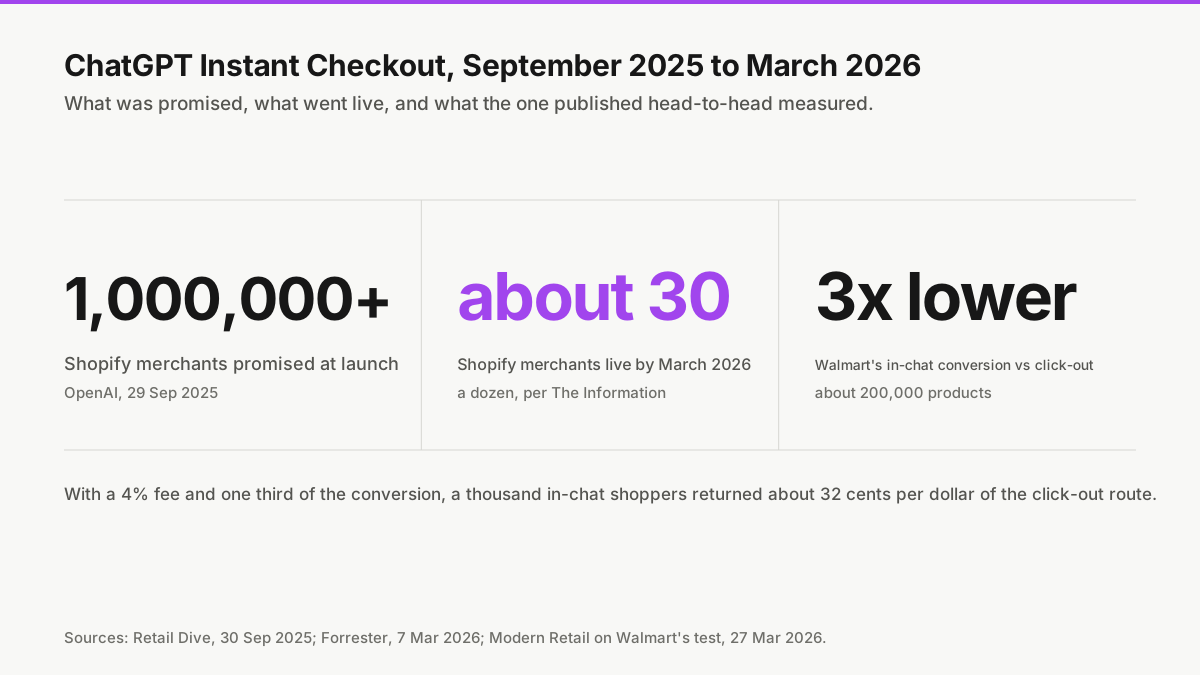
Walmart's test is the only head-to-head comparison of an in-chat checkout against a merchant's own that any retailer has published, and the result was not close. Combine the two things OpenAI's merchants knew, a 4% fee and a conversion rate one third of the site's, and a thousand shoppers sent through in-chat checkout returned about 32 cents of net revenue for every dollar the same thousand shoppers returned when sent to the store. Walmart replaced the feature with its own app inside ChatGPT. Etsy, which told investors ChatGPT orders "skew higher value," did the same.
Nobody should read this as agentic commerce failing. Etsy's agentic traffic grew 15x in a year and was still under 1% of visits, which means it started from under 0.07%. The growth is real; the base is tiny; and the checkout that works is the merchant's.
2. Shopify's own series, with the bases kept straight
Shopify has reported AI-sourced traffic and orders on four consecutive earnings calls. The figures get mashed together in coverage, so here they are with the comparison each one actually uses.
| Call | AI traffic | AI orders | Basis |
|---|---|---|---|
| Q3 2025 (4 Nov 2025) | about 7x | 11x | since January 2025 |
| Q4 2025 (11 Feb 2026) | not stated | 15x | since January 2025 |
| Q1 2026 (5 May 2026) | 8x | nearly 13x | year over year |
| Q2 2026 (5 Aug 2026) | 3x | 3x | year over year |
The Q2 figure looks like a collapse and is not. By Q2 2025 the base already included a year of growth, so a 3x on it is a larger absolute increase than the 13x on the near-zero base of Q1 2025. Harley Finkelstein said the same thing on every call in different words: "on a small base," "it's still very early days," and in August, "the volume relative to $116 billion GMV is small." Shopify has never disclosed the AI share of GMV. If it were 1%, agent-sourced orders would be about 1.16 billion dollars a quarter; if 0.5%, about 580 million. Both are consistent with "small" and both are larger than most categories of Shopify app.
What Shopify has disclosed is behaviour, and the behaviour is the point.
| Q2 2026 finding | Figure |
|---|---|
| AI-referred sessions landing directly on a product page | half, 2.5x the rate for traditional search |
| AI search conversion vs traditional organic search | nearly 80% higher |
| Conversion when the assistant used Shopify Catalog vs scraped data | 2x |
| AI-attributed orders from outside the top 100 product categories | 75% |
| New-buyer orders via AI channels vs other channels | nearly 2x |
| Traditional search sessions, two-year change | up 1.3x, still about a third of storefront sessions |
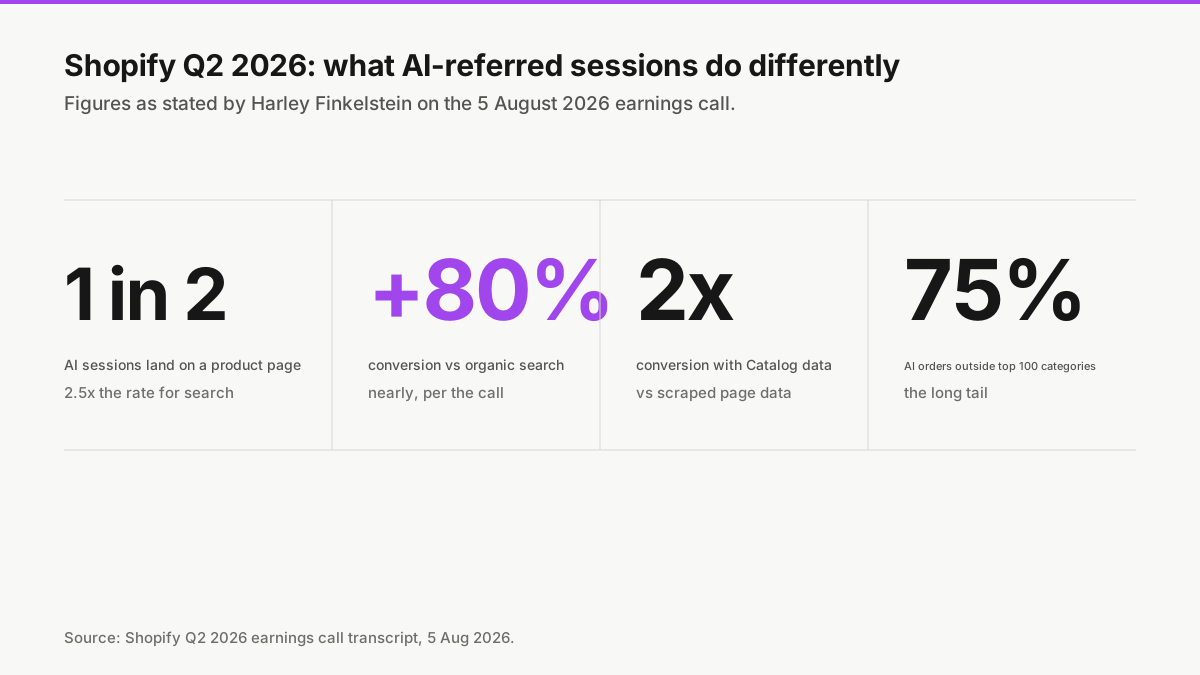
Three of those rows are about where the shopper lands and how specific the demand is. The assistant does the comparison, sends the shopper to one product page, and that product is more often than not outside the top 100 categories. That is the long tail being routed by machines, and it is exactly the kind of demand a small store with a specific catalog wins or loses on whether the assistant could read its pages.
3. The platforms are switching it on for you
Default-on is now the pattern across every surface.
| Date | Platform | What happened |
|---|---|---|
| 8 Jan 2026 | Microsoft Copilot Checkout | Shopify merchants enrolled automatically with an opt-out |
| 11 Jan 2026 | Google Universal Commerce Protocol | Co-developed with Shopify, Etsy, Wayfair, Target, Walmart; 20+ endorsers |
| 24 Mar 2026 | Shopify Agentic Storefronts in ChatGPT | On by default for eligible stores; opt-out takes up to 7 days |
| 20 May 2026 | Google Universal Cart | Checkout via Google Pay with Nike, Sephora, Target, Walmart, Wayfair |
| 18 to 22 Sep 2026 | Google native checkout in AI Mode and Gemini | Shopify stores matched to Merchant Center and enrolled; "eligible products are automatically included" |
Adoption by merchants' own choice looks very different. In May 2026 a scan of 3 million sites found 26 publicly detectable UCP endpoints, none on the primary domains of the January launch partners. Four months later Google enrolled every eligible US Shopify store by email. The merchant's decision has been replaced by the platform's.
In parallel, the scale of the surfaces the stores now sit in:
| Surface | Users | Date |
|---|---|---|
| ChatGPT | 900 million weekly (Feb 2026); OpenAI products 1.2 billion weekly (Sep 2026) | OpenAI |
| Google AI Mode | over 1 billion monthly | Alphabet Q2 2026 |
| Google AI Overviews | over 2.5 billion monthly | Google I/O, May 2026 |
| Gemini app | 950 million monthly | Alphabet Q2 2026 |
| Amazon Rufus / Alexa for Shopping | over 350 million customers in 12 months | Amazon Q2 2026 |
Shopping is a small share of what people do in these products. OpenAI's own usage study put "purchasable products" at roughly 2% of ChatGPT messages in mid-2025. Two percent of a billion weekly users is still a shopping surface larger than most retailers' entire traffic.
4. What shoppers will and will not let the agent do
The consumer research is unusually consistent, and it explains why click-out won.
| Finding | Figure | Source |
|---|---|---|
| US consumers who would let AI make the purchase decision, even for household supplies | 11% at most | Gartner, Jan 2026 |
| Would let AI narrow the choices for household supplies | 31% | Gartner, Jan 2026 |
| Had to double-check AI-provided information | 54% | Gartner, Nov to Dec 2025 |
| Not comfortable letting AI handle a transaction end to end | 50% | Bain, Nov 2025 |
| Trust a retailer's own agent vs a third-party agent | 3x more | Bain, Nov 2025 |
| Used ChatGPT for product search in the past month: Gen Z / millennials / Gen X | 35% / 32% / 23% | Forrester, Dec 2025 |
| Made at least one AI-assisted purchase in the past month | about 23% | Morgan Stanley, Dec 2025 |
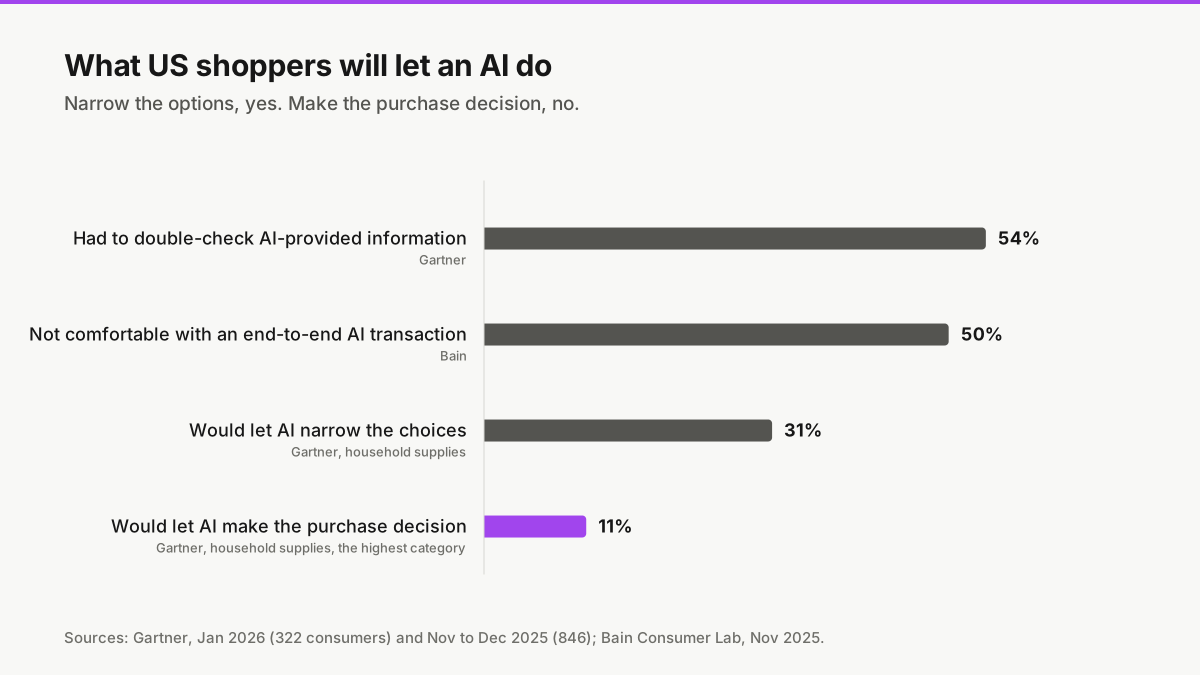
Shoppers want the assistant to shortlist and the store to sell. Walmart measured it, OpenAI conceded it, and the consumer surveys predicted it.
5. The forecasts, and why they disagree
| Forecast for 2030 | US figure | Definition |
|---|---|---|
| Morgan Stanley, Dec 2025 | $190 billion base, $385 billion bull; 10% to 20% of US ecommerce | agent-executed purchases |
| Bain, Dec 2025 | $300 to $500 billion; 15% to 25% of US ecommerce | purchases initiated, influenced or completed by an agent |
| McKinsey, Oct 2025 | up to $1 trillion US B2C; $3 to $5 trillion global | revenue "orchestrated" by agents |
These are not competing estimates of one quantity. Morgan Stanley counts the agent pressing buy; Bain counts the agent being in the journey; McKinsey counts the agent influencing the outcome. The spread between 190 billion and 1 trillion is almost entirely the definition. The honest summary is that every analyst expects agents to be in the path of at least one dollar in ten of US online retail by 2030, and the only disagreement is how much of the rest they touch.
What this means for a Shopify store this quarter
- You are already listed. Unless you opted out, your products are in ChatGPT, Copilot, and (if matched to Merchant Center) Google's AI Mode checkout. Search your own store name and best product in each and read what it says.
- The conversion happens on your product page. Half of AI sessions land there. If the page cannot answer the question the shopper asked the assistant, you were recommended and then lost, and that loss appears nowhere.
- Catalog data beats scraped data 2 to 1. Shopify Catalog sends your structured product data automatically. Whether it is complete is up to you; variant, stock and shipping facts are where the gaps usually are.
- Measure it as a channel now, while it is small. The quarter when AI orders stop being "small relative to GMV" will not be announced in advance. Product Gale's scan shows what the assistant currently says about your store and where its journey stops, and the traffic tag counts the visits that follow.
Sources
- Shopify, agentic commerce momentum, 24 Mar 2026: shopify.com; selling in ChatGPT: help.shopify.com
- Shopify Q4 2025 call transcript, 11 Feb 2026: platformaeronaut.com; Q1 2026: fool.com; Q2 2026: investing.com
- TechCrunch on Shopify Q3 2025, 4 Nov 2025: techcrunch.com; on Q2 2026, 5 Aug 2026: techcrunch.com
- Forrester, what it means that the leader in agentic commerce just pulled back, 7 Mar 2026: forrester.com
- Digital Commerce 360 on OpenAI's 24 Mar 2026 changes: digitalcommerce360.com; Modern Retail, what went wrong with Instant Checkout, 27 Mar 2026: modernretail.co
- Retail Dive on the Instant Checkout launch, 30 Sep 2025: retaildive.com
- Etsy Q4 2025 call transcript, 19 Feb 2026: fool.com
- Google, UCP launch, 11 Jan 2026: blog.google; Google Marketing Live, 20 May 2026: blog.google; Alphabet Q2 2026 remarks: blog.google
- PPC Land on Google's Shopify auto-enrolment, 23 Sep 2026: ppc.land; on UCP adoption, 21 May 2026: ppc.land; on Copilot Checkout, 10 Jan 2026: ppc.land
- TechCrunch, ChatGPT reaches 900M weekly users, 27 Feb 2026: techcrunch.com; OpenAI DevDay, 29 Sep 2026: techcrunch.com
- NBER Working Paper 34255, how people use ChatGPT, Sep 2025 (PDF): cdn.openai.com
- Amazon Q2 2026 results: aboutamazon.com
- Gartner consumer survey, 27 May 2026: gartner.com
- Bain, agentic AI in retail, 13 Nov 2025: bain.com; 2030 forecast, 17 Dec 2025: bain.com
- Digital Commerce 360 on Morgan Stanley's forecast, 9 Dec 2025: digitalcommerce360.com; on McKinsey's, 20 Oct 2025: digitalcommerce360.com
Keep reading
What ChatGPT Reads Before It Recommends a Product, in Numbers
On 10 July 2026 the share of ChatGPT Shopping recommendations sourced from merchant feeds jumped from 8% to 62% in a single day, and two thirds of tracked brands lost a third of their visibility. Adobe says a third of product page content is unreadable to machines. The accuracy and benchmark studies explain why these two facts are the same story.
AI Referrals Went From the Worst Retail Channel to the Best in Twelve Months. Here Is the Full Series.
Adobe has published AI referral data for US retail every quarter since late 2024. Lined up end to end, the series shows a channel that grew 14x, flipped from converting 38% worse to 60% better, and is still mostly invisible to the stores receiving it.