What ChatGPT Reads Before It Recommends a Product, in Numbers
On 10 July 2026 the share of ChatGPT Shopping recommendations sourced from merchant feeds jumped from 8% to 62% in a single day, and two thirds of tracked brands lost a third of their visibility. Adobe says a third of product page content is unreadable to machines. The accuracy and benchmark studies explain why these two facts are the same story.
Product Gale Team
What ChatGPT Reads Before It Recommends a Product, in Numbers
A merchant asks ChatGPT about their own product and gets the wrong price. The instinct is to call it a hallucination and move on. The measurements published in 2026 say something more useful: the assistant was working from what it could read, and what it could read was incomplete.
This article collects every quantified study we could verify on three questions. How much of a product page can a machine read? What does the assistant cite when it recommends? And how often is the answer wrong? The numbers connect.
1. A third of the product page is not there
Adobe scores retail pages with its AI Content Visibility Checker, where a score of 50% means half the page's content is not machine-readable. Across US retail:
| Page type | Readability score |
|---|---|
| Returns and exchanges | 82% |
| FAQ | 80% |
| Homepage | 75% |
| Category page | 74% |
| Product page | 66% |
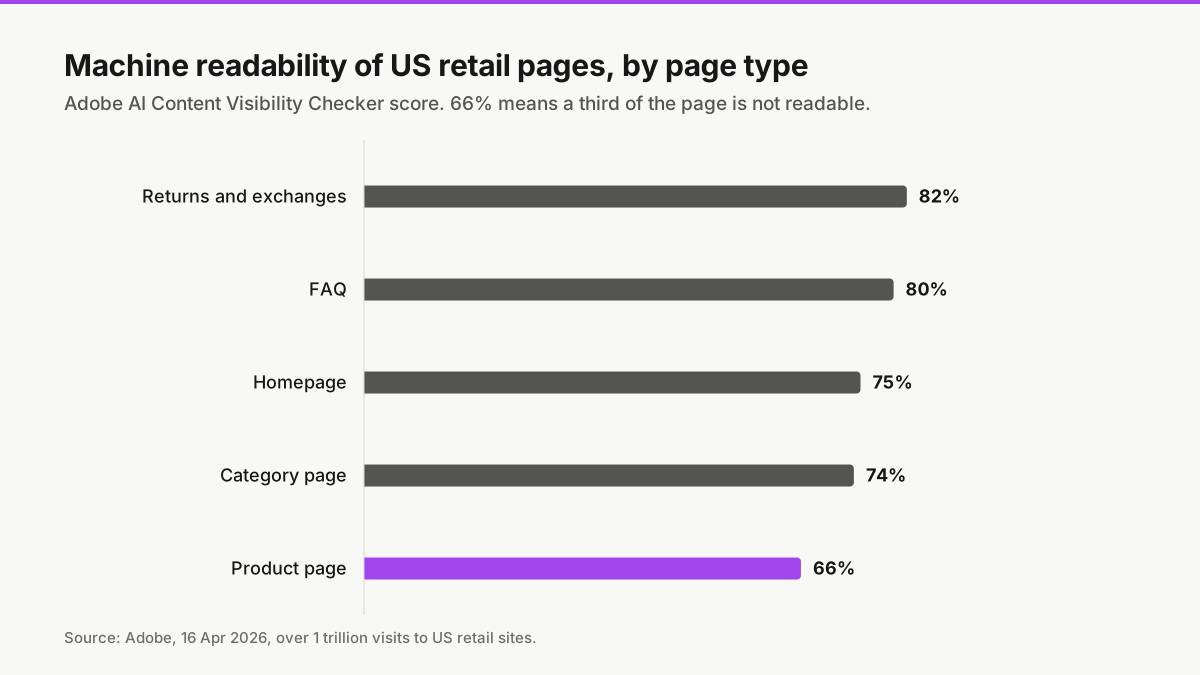
The product page, the one page the shopper is sent to, is the least readable page on the site. By vertical, in May 2026, the averages were lower still because they blend all page types: cosmetics 63%, electronics 56%, sporting goods and apparel 51%, grocery 48%, furniture and home 47%. Adobe's Vivek Pandya said by email in June that "sizable portions of retailers' websites, up to 46% in some cases, are not readable by machines."
A direct test of four big-box product pages in August 2026 shows what the missing third is. MarketerFirst compared the text a shopper sees with what is present in the server HTML, which is what a non-rendering crawler receives.
| Retailer | Visible text blocks absent from server HTML | Product JSON-LD |
|---|---|---|
| Target | 80% | none, and no price anywhere in the HTML |
| Wayfair | 63% | none |
| Best Buy | 59% | present |
| Home Depot | 49% | present |
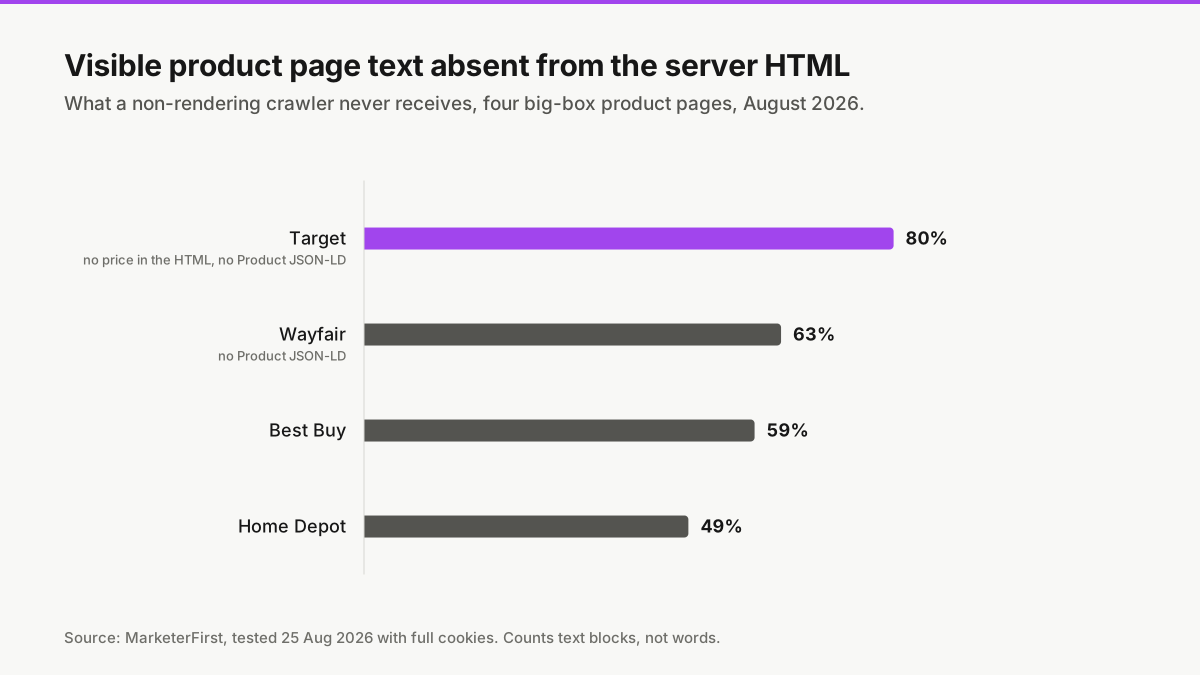
On Target's page the headings "Specifications" and "Size Guide" arrive with nothing beneath them, because the content loads later from an API call. The December 2024 Vercel study found that none of the major AI crawlers rendered JavaScript, and no 2026 study has found otherwise. A crawler that reads Target's page sees a product with a name and no price.
Shopify stores do better by default. Dawn and Horizon emit Product JSON-LD with price, currency, availability and URL for every product. What they do not emit is a GTIN, SKU or MPN, the identifiers a feed matches on, and invalid GTINs were already the most common product feed error in the last DataFeedWatch report, affecting 48% of merchants.
2. The day the sourcing changed
Profound tracks what ChatGPT Shopping shows for a large daily sample of prompts. In June 2026, 12.7% of product cards came from merchant product feeds and 87.3% from web crawl. Then, on 10 July 2026, the day after GPT-5.6 shipped, this happened:
| Date | Share of ChatGPT Shopping recommendations sourced from feeds |
|---|---|
| June 2026 (monthly) | 12.7% |
| 9 July 2026 | 8.26% |
| 10 July 2026 | 61.54% |
| 3 September 2026 | about 65% |
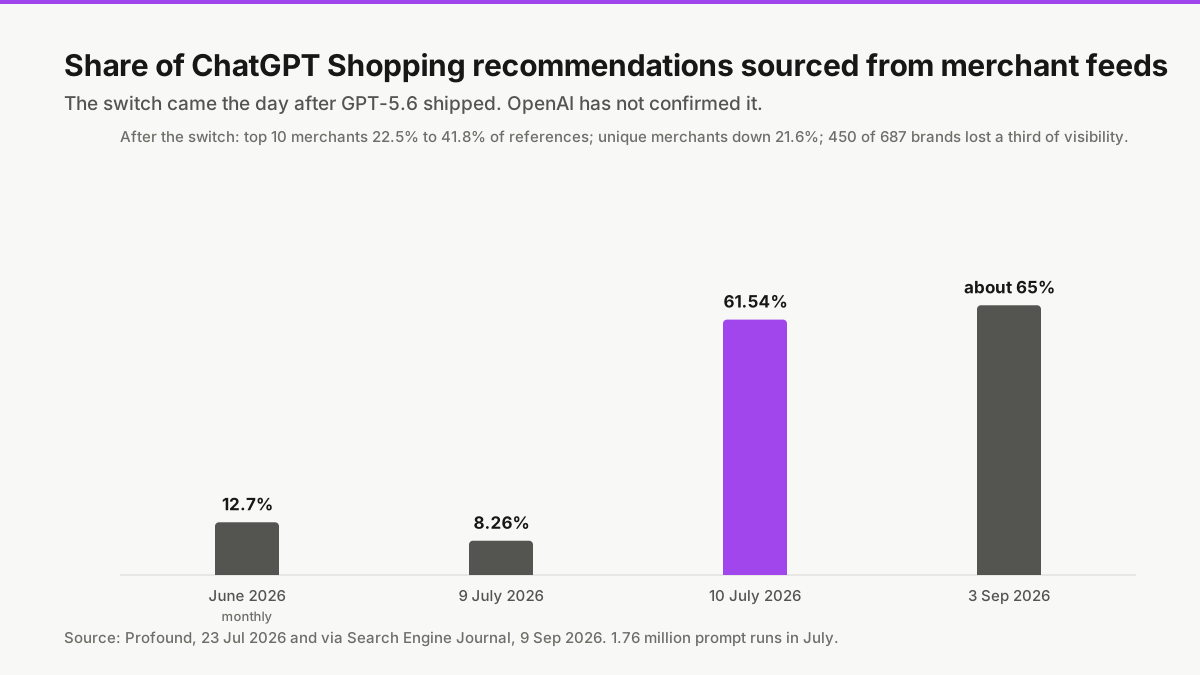
The consequences, over the following days, on a sample of 1.76 million prompt runs:
- The top 10 merchants went from 22.5% to 41.8% of all references.
- Unique merchants cited fell from 13,524 to 10,607, a 21.6% drop.
- 450 of 687 tracked brands, 65.5%, lost at least a third of their Shopping visibility within three days.
- Shopify stores are an estimated 35% of feed-based retrieval, because Shopify Catalog connects merchants' product data automatically.
OpenAI has not confirmed the change. The data is one vendor's panel. But the direction is consistent with what Shopify reported on its Q2 call, that AI searches using Catalog data converted at twice the rate of those using scraped data, and with what OpenAI's merchant page says: Shopify and Etsy catalogs connect automatically, everyone else applies.
For a Shopify store the implication is specific. Your feed is on. What is in it is what the assistant now works from. Scraped page content, which carried 87% of recommendations in June, carries a third of them in September.
3. What gets cited, and who does not
Where the answer comes from a web page rather than a feed, the studies agree on one thing: brand sites are not where assistants look for product advice.
| Study | Sample | What retailers and brands get |
|---|---|---|
| Cloro, May 2026 | 3,312 product-intent responses, 6 engines | YouTube 19% and Reddit 19% of responses; Amazon 5%; brand domains "conspicuously absent" |
| LLM Pulse, Aug 2026 | 391,073 citations, generic shopping queries | All retailers and marketplaces combined 2.9%; ChatGPT cited amazon.com 6 times in the whole sample |
| Ahrefs Brand Radar, Sep 2026 | ChatGPT's most cited domains | reddit.com 16.8%, Wikipedia 7.0%; walmart.com first retailer at #10 with 2.3%; Amazon not in the top 50 |
| Profound, Jul 2026 | 3.3 million ChatGPT Shopping citations | Reddit about one third of shopping citations |
| Semrush, Jun 2026 | 3,981 domain appearances, 4 engines | 61.7% of citations are "ghost citations": the page is linked but the brand never named |
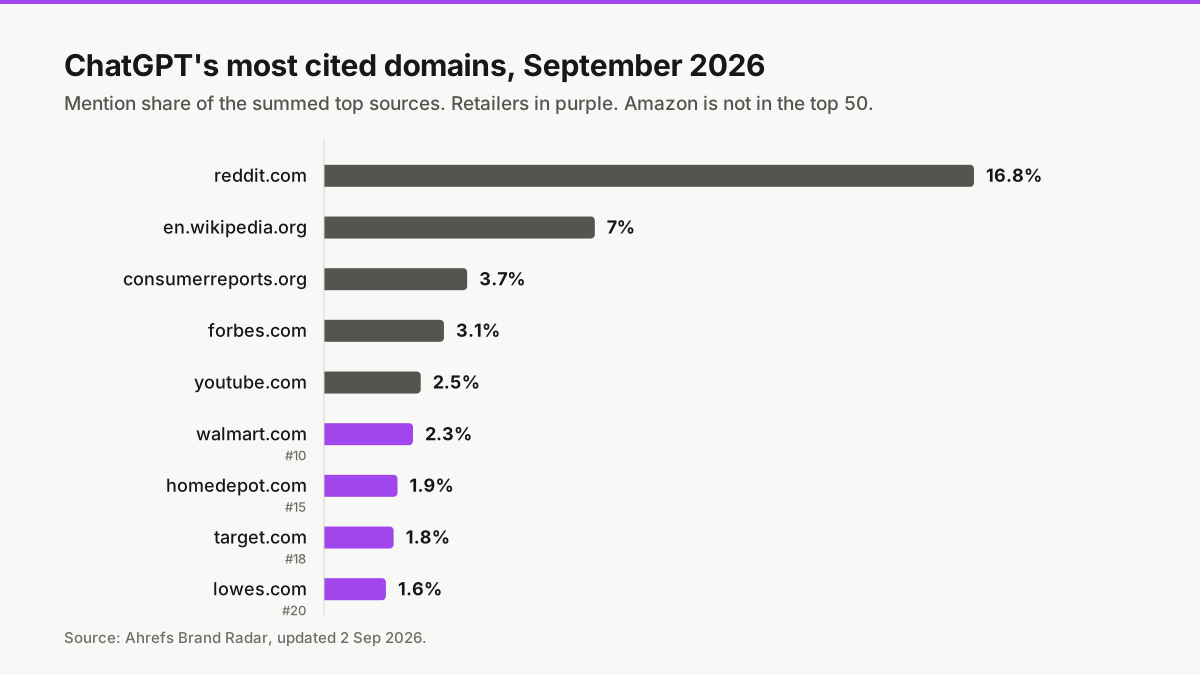
Two findings in that list should reset expectations. The first is LLM Pulse's: on generic shopping questions, brand and manufacturer sites take 64.7% of citations, which sounds encouraging until you see that the assistant is citing them for facts, not recommending them, and that all retailers combined are under 3%. The second is Semrush's: six in ten citations are a link with no mention of the brand. Being a source is not being recommended.
Reddit's position is also unstable. In mid-August 2026 ChatGPT cut its Reddit citations by 73% in four days while brand and competitor pages rose in 10 of 15 tracked reports. The sources shift by release; the product page is the one input the merchant controls.
4. How often the answer is wrong
Product.ai asked the free and paid tiers of ChatGPT, Gemini, Claude and Perplexity 220 shopping questions, five times each, in September 2026.
| Finding | Figure |
|---|---|
| Prompts with a repeatable conflict in price, spec or availability | 86% |
| Product comparison requests with a conflict | 97% |
| Median size of a wrong price | $300 |
| Share of questions with a costly pricing error, best engine (Perplexity) | 14% to 15% |
| Share with a costly pricing error, worst engine (Gemini) | 54% to 56% |
| Share with a likely fabricated claim, ChatGPT | 6% to 7% |
The authors' summary: "There was almost no middle ground between exactly right and badly wrong." Google disputed the study's use of its developer API rather than the consumer app. The pattern is consistent with every other source here regardless: when the page does not state the price in a form the machine can read, the machine's price comes from somewhere else.
The academic benchmarks make the same point from the agent's side. In every 2026 shopping-agent benchmark, the best model completes well under two thirds of tasks.
| Benchmark, 2026 | Best agent success |
|---|---|
| ComboShoppingBench, 291 basket tasks | 61.2% |
| ShoppingBench, 2.5 million real products | 48.2% |
| Odysseys, long-horizon web tasks (43 ecommerce) | 44.5% |
| ShoppingComp, expert-curated scenarios | 17.8% |
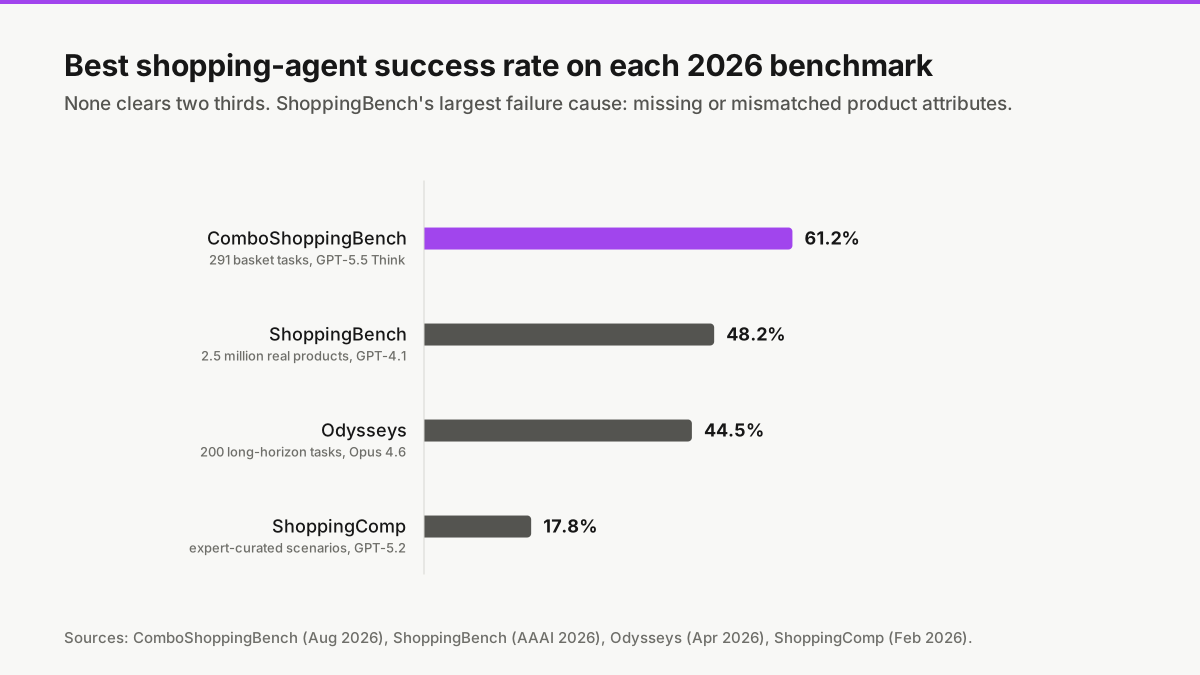
ShoppingBench's authors wrote that "the largest proportion of failures is due to missing or mismatched product attributes." And the Odysseys paper recorded, in 23 runs, what an agent does when the rendered page fails: it reads the page source and "extracts structured product metadata from embedded JSON-LD markup," including variant identifiers, stock status and size mappings. The structured data was the fallback that rescued the task.
5. Does adding structured data help? The honest answer
Three 2026 studies, three answers.
- Ahrefs matched 1,885 pages that added JSON-LD against controls, 30 days before and after. Effect on ChatGPT citations: +2.2%, statistically indistinguishable from zero. Yet in the same 6 million URL screen, pages that AI engines cited were almost three times more likely to carry JSON-LD.
- AirOps, across 353,799 pages, found pages with JSON-LD were cited by ChatGPT 38.5% of the time against 32.0% without, a 6.5 point advantage, correlational.
- Otterly added schema to one site and watched ChatGPT citations fall 71% while AI Overviews rose several hundred percent. One site, weak evidence.
Our reading is that schema is table stakes, not a lever. It does not make the assistant recommend you. It makes the price, stock and variant facts available when the assistant is already looking at you, which, per Odysseys and ShoppingBench, is exactly the moment where the recommendation is won or lost on attributes.
What to check on your own store
- Fetch a product page the way a crawler does. Request it without JavaScript and look for the price, the stock status and the variant options in the HTML or the JSON-LD. If any of the three is missing, that is what the assistant is missing.
- Open your Shopify Catalog feed as the assistant sees it. Since July, this is the primary input. Check the attributes the feed is sending for your top 20 products against what the page says.
- Ask the assistants and record the answers. Twenty shopper questions, five engines, with the price and stock they quote. Compare to your store. Product Gale's scan does this and shows the trace, including the step where the agent gave up.
- Re-check after each model release. The July switch happened in a day. The citations it uses moved again in August. A scan from the spring describes a different ChatGPT.
Sources
- Adobe, Q1 2026 AI traffic and machine readability, 16 Apr 2026: business.adobe.com; Digital Commerce 360 on Adobe's May 2026 readability data, 17 Jun 2026: digitalcommerce360.com; CMSWire on Prime Day 2026, 24 Jun 2026: cmswire.com
- MarketerFirst, what AI crawlers can read on product pages, 26 Aug 2026: marketerfirst.com
- Vercel and MERJ, the rise of the AI crawler, 17 Dec 2024: vercel.com
- Shopify, structured_data Liquid filter: shopify.dev; Dawn theme source: github.com
- Search Engine Land on the DataFeedWatch feed error report: searchengineland.com
- Profound, ChatGPT Shopping end to end, 23 Jul 2026: tryprofound.com; the GPT-5.6 shopping transformation: tryprofound.com; Search Engine Journal, 9 Sep 2026: searchenginejournal.com
- OpenAI merchant page: chatgpt.com/merchants; Agentic Commerce Protocol feed spec: agentic-commerce-protocol.com
- Cloro, what ChatGPT recommends, 26 May 2026: cloro.dev
- LLM Pulse, where AI sends shoppers, 17 Aug 2026: llmpulse.ai
- Ahrefs, most cited domains in ChatGPT, 2 Sep 2026: ahrefs.com; schema and AI citations, 11 May 2026: ahrefs.com
- Semrush with Kevin Indig, the ghost citations study, 9 Jun 2026: semrush.com
- Otterly, ChatGPT Reddit citations, 27 Aug 2026: otterly.ai; schema markup impact: otterly.ai
- AirOps with Kevin Indig, the fan-out effect, 13 Apr 2026: airops.com
- Product.ai divergence study, via AndroidHeadlines, 22 Sep 2026: androidheadlines.com; Tech.co, 25 Sep 2026: tech.co
- ShoppingBench (AAAI 2026): arxiv.org; ComboShoppingBench: arxiv.org; ShoppingComp: arxiv.org; Odysseys: arxiv.org
Keep reading
Every Shopify Store Is in ChatGPT by Default. The Numbers Say the Sale Still Happens on Your Site.
Shopify switched Agentic Storefronts on for millions of merchants in March 2026, the same week OpenAI wound down Instant Checkout. The published figures from Shopify, Walmart, Etsy, Google and Gartner all point the same way: assistants discover, stores convert.
Bots Passed Humans This Year. Here Is What the AI Ones Actually Do on a Store.
Cloudflare, Akamai, Fastly, HUMAN and DataDome all published edge data on AI bots in 2026. Put together, the numbers show retail absorbing nearly half of all AI bot traffic, agents spending 77% of their time on product and search pages, and Shopify's own reports hiding the whole thing.