Supplements in AI Answers: Chatbots Did Worst on Nutrition. The FTC Still Judges Your Page.
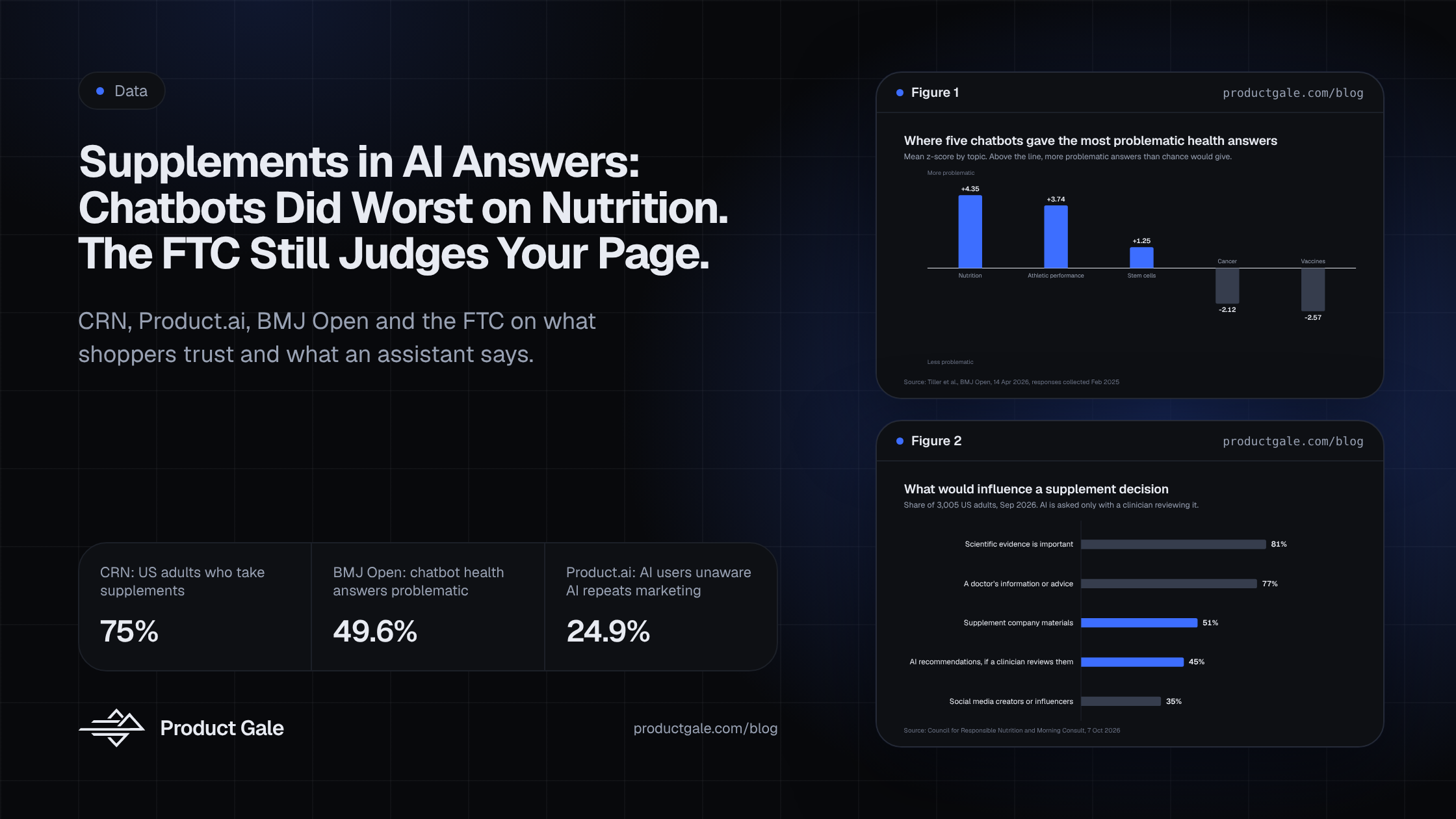
CRN says 75% of US adults take supplements. A BMJ Open audit found 49.6% of chatbot health answers problematic, with nutrition the weakest topic. Product.ai found 24.9% of AI shoppers did not know an assistant can repeat brand marketing as fact. The FTC rules sit beside them.

Product Gale Team
"45% of U.S. adults say they would be comfortable using personalized AI supplement recommendations." That line is from the Council for Responsible Nutrition's 2026 consumer survey, published on 7 October, and it has already started to travel without the rest of its sentence. The rest is "if reviewed by a doctor, pharmacist or registered dietitian." It is a conditional answer, not a count of people who ask an assistant about supplements today; CRN does not give that number.
Supplements are a category where what a seller may say is narrow and written down, and where an assistant can turn a careful product page into a broader claim of its own.
We put four 2026 sources side by side: CRN's survey of supplement users, Product.ai's survey of how shoppers trust AI by category, a peer-reviewed audit of chatbot health answers in BMJ Open, and the Federal Trade Commission's most recent supplement order. We read them against the FTC's health products guidance and the FDA's rules for structure and function claims.
1. Three in four adults take supplements, and they say evidence matters
CRN's survey was run by Morning Consult among 3,005 US adults from 11 to 13 September 2026, with a margin of error of plus or minus 1.8 points. It found that 75% currently use dietary supplements, including 46% who use them regularly.
Then it asked what would influence a decision about whether a supplement is right for them.
| What would influence a supplement decision | Share of US adults | Source, period |
|---|---|---|
| Scientific evidence is very or somewhat important | 81% | CRN and Morning Consult, Sep 2026 |
| Information or advice from a doctor | 77% | CRN and Morning Consult, Sep 2026 |
| Supplement company materials | 51% | CRN and Morning Consult, Sep 2026 |
| AI recommendations, if reviewed by a clinician | 45% | CRN and Morning Consult, Sep 2026 |
| Social media creators or influencers | 35% | CRN and Morning Consult, Sep 2026 |
Two rows matter for a store: company materials, at 51%, ahead of influencers, and evidence, at 81%.
A caution on the AI row, because it is the one being quoted. It is not a usage figure. It measures comfort with a recommendation a professional has checked, and it was asked as a separate question from the influence list. Read it as a ceiling on trust under supervision, not as a share of shoppers who ask ChatGPT.
2. Shoppers use AI to research, and trust it a little less for health
Product.ai, a company that sells verification products for commerce, publishes a recurring survey of US shoppers. Edition 2, published on 14 October 2026, surveyed 1,493 shoppers between 27 August and 1 September 2026. It found that 41.5% of online shoppers used an AI assistant to research a purchase in the past 90 days, and that 89.9% of those AI users checked its recommendation through another source before buying.
It also asked every respondent how much they trust AI product recommendations in each of 18 categories, on a 1 to 7 scale.
| Category | Mean trust in AI recommendations, 1 to 7 | Source, period |
|---|---|---|
| Kitchen appliances (highest) | 3.98 | Product.ai, Aug to Sep 2026 |
| Electronics | 3.97 | Product.ai, Aug to Sep 2026 |
| Skincare | 3.82 | Product.ai, Aug to Sep 2026 |
| Supplements and health | 3.81 | Product.ai, Aug to Sep 2026 |
| Beauty | 3.73 | Product.ai, Aug to Sep 2026 |
| Baby products and child safety (lowest) | 3.67 | Product.ai, Aug to Sep 2026 |
| Mean of all 18 categories | 3.87 | Product.ai, Aug to Sep 2026 |
The gaps are small, and the report says why the levels look low: 16.0% of the sample answered "do not trust at all" for every category, and without them every category sits above the scale midpoint. The report treats the rank order as the finding, not the level, and so do we. The sample is not weighted to Census distributions. What the order says is modest and consistent: the categories that touch the body, from supplements to beauty to baby products, sit in the lower half.
Lower trust does not mean shoppers ignore the answer: 61.1% of AI users said AI shopping answers are usually accurate about product specifications.
3. Chatbots answered nutrition questions worst of five health topics
How good are the answers? The most directly relevant peer-reviewed audit we found was published in BMJ Open on 14 April 2026 by Tiller and colleagues. In February 2025 they put 10 questions from each of five topics, cancer, vaccines, stem cells, nutrition and athletic performance, to five chatbots: Gemini, DeepSeek, Meta AI, ChatGPT and Grok. Two experts per topic rated each response.
| Measure | Result | Source, period |
|---|---|---|
| Responses rated problematic | 49.6% | BMJ Open, responses Feb 2025 |
| Somewhat problematic | 30% | BMJ Open, responses Feb 2025 |
| Highly problematic | 19.6% | BMJ Open, responses Feb 2025 |
| Refusals to answer | 2 of 250, 0.8% | BMJ Open, responses Feb 2025 |
| Median completeness of references | 40% | BMJ Open, responses Feb 2025 |
The paper reports topic performance as mean z-scores, where a positive score means more problematic answers than a random spread would give.
| Topic | Mean z-score | Source, period |
|---|---|---|
| Nutrition | +4.35 | BMJ Open, responses Feb 2025 |
| Athletic performance | +3.74 | BMJ Open, responses Feb 2025 |
| Stem cells | +1.25 | BMJ Open, responses Feb 2025 |
| Cancer | -2.12 | BMJ Open, responses Feb 2025 |
| Vaccines | -2.57 | BMJ Open, responses Feb 2025 |
The two worst topics, nutrition and athletic performance, are the two where supplements are sold. The authors add that answers were "consistently expressed with confidence and certainty"; there were two refusals in 250 questions.
Cautions, by name. The prompts were adversarial by design, written to strain the models toward misinformation, so the rates describe a stress test, not an average shopper's question. The topic was nutrition, not supplement product pages. The responses are from February 2025, and every model has been updated since. The paper is a reason to look at what an assistant says about your category, not a rate to quote for your products.
Product.ai's companion study adds the shopping side. Querying four assistants through their developer APIs with the same shopping questions, it found a confirmed conflict between answers 75% of the time on plain spec and fact lookups, the question type on which the assistants agreed most. Set beside the 61.1% of AI users who believe AI is usually accurate on specifications, that is the gap a supplement shopper stands in.
4. The assistant reads your marketing. The FTC judges what it implies.
Product.ai asked AI users whether, before the survey, they knew that an AI answer can repeat a brand's own marketing claims as if they were facts.
| Did AI users know AI can repeat brand marketing as fact? | Share of AI users | Source, period |
|---|---|---|
| Knew | 36.4% | Product.ai, Aug to Sep 2026 |
| Suspected | 38.7% | Product.ai, Aug to Sep 2026 |
| Did not know | 24.9% | Product.ai, Aug to Sep 2026 |
In the same survey, 48.7% agreed that AI shopping answers are unbiased and not influenced by advertisers or brands. Half of AI users hold both views at once.
For a supplement brand, that is where the regulators come in. The FTC's Health Products Compliance Guidance says health claims need "competent and reliable scientific evidence," generally randomized, controlled human trials relevant to the specific product, dose and benefit. Three sentences in it matter most here:
- "A marketer is equally responsible for the accuracy of claims suggested or reasonably implied in advertising." Ads are judged by the net impression of all their elements, and where an ad supports more than one reading, "the advertiser is responsible for substantiating each interpretation."
- The disclaimer that supplement labels carry under the Dietary Supplement Health and Education Act "won't cure an otherwise deceptive ad."
- Compliance with the FDA's notification and disclaimer rules "doesn't constitute FDA authorization," and DSHEA "has no effect on the FTC Act."
The FDA's rule is the other half. A label may describe how an ingredient affects the normal structure or function of the body, with a disclaimer that the product is not intended to "diagnose, treat, cure or prevent any disease." A disease claim is off limits: "only a drug can legally make such a claim."
The FTC is enforcing this in 2026. On 15 July it finalized an order against a seller of height supplements for children and teens, saying the company "lacked competent and reliable scientific evidence" for its growth claims; the complaint also alleged fake reviews. The order requires a payment of $750,000 against a $4 million judgment, partially suspended for inability to pay, and bars buying reviews conditioned on positive or negative sentiment.
No document we read says who answers for an assistant's paraphrase of a product page, and we would not guess. What the guidance does settle is the page: the FTC judges what it implies, not only what it says. An assistant that reads "supports a calm mood" next to five reviews about anxiety, and answers a shopper's question about anxiety, is doing exactly the reading the net impression standard describes, and saying the implied claim out loud. The reviews matter as much as the copy, which is why the order above reached them.
What to check on your own store
None of these averages describes your store. Look at your own pages the way an assistant does.
- Read your claims as one paragraph. Strip the page to text and read the headline, the bullets, the reviews and the FAQ together. That net impression is what the FTC judges and what a model summarizes. If it implies a disease benefit your evidence does not support, an assistant can state it more plainly than you did.
- Put the evidence where a machine can read it. 81% of adults say scientific evidence matters. If your studies, doses and populations live in a PDF or an image, the assistant answering the evidence question cannot see them. State them in the page's own text, with the structure and function wording and the disclaimer the FDA requires.
- Ask the questions your shoppers ask. Ask an assistant whether one of your products helps with a named condition, how much to take, and whether it is safe with a common medication, and read the answer against your label. Product Gale's scan shows what an assistant currently reads and says about your product pages, and where its journey stops; you can see one on a sample store before running it on your own.
- Audit the reviews you display. Reviews are page content too, and the July order shows the FTC reaches them. Keep only real reviews, never paid for a sentiment, and know which ones make health claims you would not make yourself.
Sources
- Council for Responsible Nutrition, 2026 consumer survey with Morning Consult, 7 Oct 2026: crnusa.org; what Americans think about supplements, 7 Oct 2026: crnusa.org
- Product.ai, The Trust in AI Commerce Report, Edition 2, 14 Oct 2026 (PDF): product.ai
- Tiller et al., generative AI chatbots and medical misinformation, an accuracy, referencing and readability audit, BMJ Open, 14 Apr 2026: doi.org
- Federal Trade Commission, final order against a seller of height supplements for kids and teens, 15 Jul 2026: ftc.gov; Health Products Compliance Guidance: ftc.gov
- US Food and Drug Administration, structure and function claims: fda.gov
Keep reading
Fit Drives Most Apparel Returns. Apparel Product Pages Are the Hardest for AI to Read.
Loop says fit and size drive 56% of apparel returns. Baymard says 48% of apparel shoppers read reviews for fit. Adobe scores apparel product pages 50% readable by AI, the lowest of six retail sectors. We set the three side by side, with Google's and OpenAI's feed rules.
Coffee Is Bought on Repeat. ChatGPT's Product Feed Has No Field for a Subscription.
The National Coffee Association says 66% of US adults drank coffee yesterday and 82% of them made it at home. Recurly says pause usage rose 337%. Shopify Catalog excludes subscriptions as add-ons, and OpenAI's feed schema carries one regular price per variant.
What are AI shoppers costing your store?
Paste your store address and the free scan starts right away. Nothing to install.
Prefer our reporting in Google
Add Product Gale as a preferred source and our posts are marked as preferred for you in Top Stories, AI Mode and AI Overviews.