We Sent a Store 500,000 AI Requests. Its Analytics Saw 2,000, All Logged as Shoppers.
We built a test store with a real analytics tag and sent it 500,000 AI requests in the mix Akamai measured on commerce sites. The server logged every one. The analytics saw 2,000, all AI agents it took for shoppers, and none of the 74,000 visits assistants made for someone's question. Scaled with Cloudflare and Adobe data.

Product Gale Team
In The Invisible Revenue Leak in Agentic Commerce, we made one claim the whole piece leaned on.
Most of what an AI agent does on your site never shows up in your analytics.
We backed it with other people's research.
We never tested it ourselves.
So we did.
We built a store, put a real analytics tag on it and sent it AI traffic. First 10,000 requests. Then 500,000.
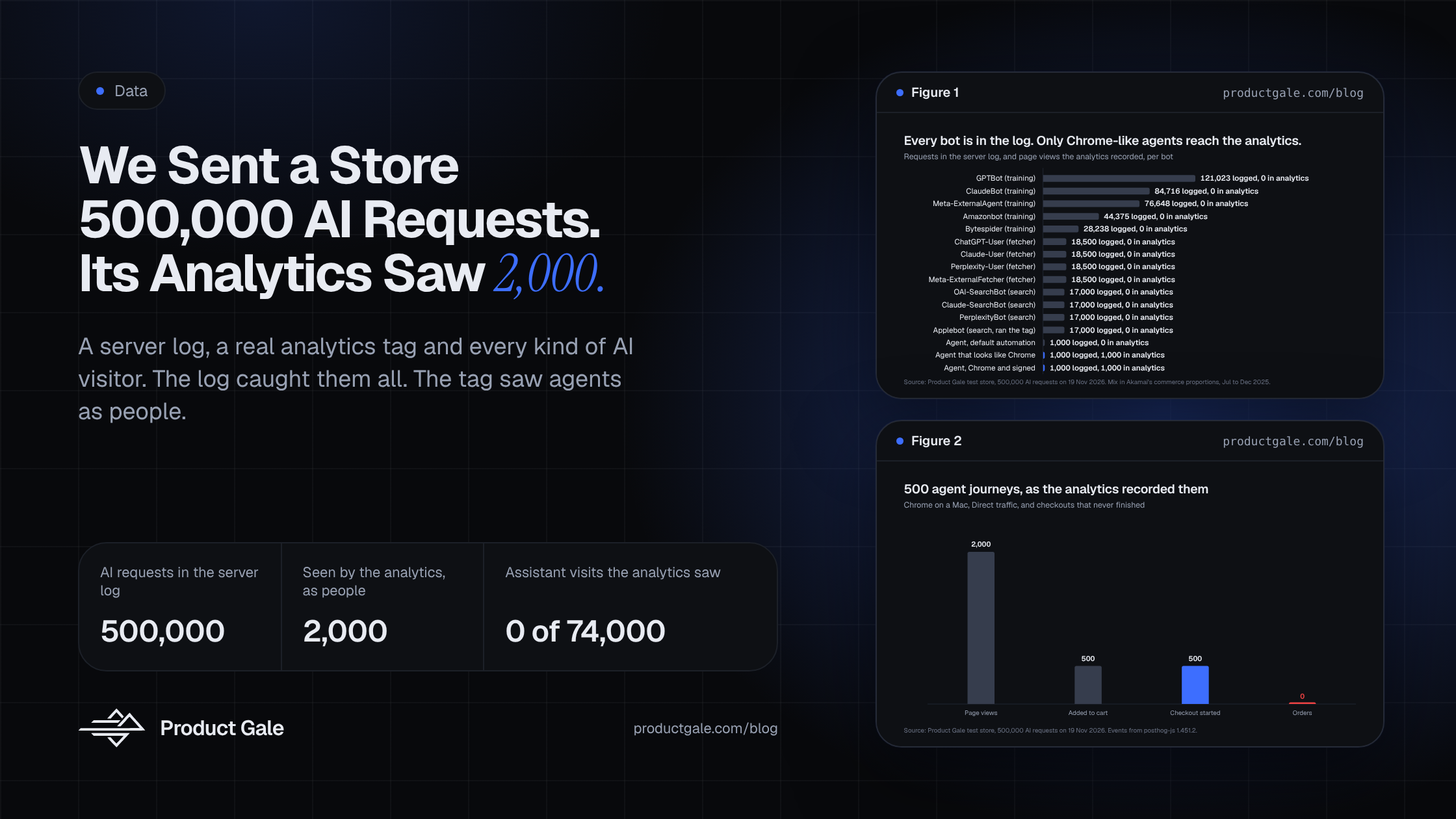
The server logged all 500,000.
The analytics saw 2,000.
That's 0.4%.
And every one of those 2,000 was an AI agent the analytics thought was a person. Desktop Chrome on a Mac. Direct traffic.
The 74,000 visits assistants made because someone asked them about a product?
Zero.
How we set it up
The question was simple: when AI visits a store, what does its analytics actually record?
We needed a store, AI traffic, and two ways to count it.
The store
| Part | What we built |
|---|---|
| Catalog | Six outdoor products. The one we watched: a rain shell at $164. |
| Pages | Home, collection, products, search, cart, checkout, policies, robots.txt. Shopify-style addresses and rules. |
| Checkout | Works right up to payment. No order can go through. |
| Product page | Price, waterproof rating, sizes in stock and returns are in the page itself. Two apps add the delivery date and the reviews, in the browser. |
Two ways to count
| Count | What it is | What it can see |
|---|---|---|
| Server log | Every request that reached the store. Your CDN or host keeps one like it. | Every visitor |
| Analytics | PostHog's open-source tracking script, unmodified, on every page, sending each event straight away. | Only visitors that run the script |
Google Analytics and ad pixels work the same way: in the visitor's browser, or not at all.
The visitors
We split the AI traffic the way Akamai measured AI bots on commerce sites in the second half of 2025. (Akamai)
| Visitor | What it does | Share | First run | Big run |
|---|---|---|---|---|
| Training crawlers | Copy pages to train AI models | 71.0% | 7,100 | 355,000 |
| Fetchers | Read a page because someone just asked an assistant about it | 14.8% | 1,480 | 74,000 |
| Search crawlers | Build the index AI search answers from | 13.6% | 1,360 | 68,000 |
| Agents | Shop for someone: search, pick a size, add to cart, start checkout | 0.6% | 60 | 3,000 |
Akamai names the first three and puts everything else, agents included, under 1%. We gave agents the whole 0.6% left. If anything, we sent too many.
- Crawlers and fetchers sent the names the real bots send: GPTBot, ClaudeBot, ChatGPT-User, Perplexity-User and nine more, with training crawlers weighted by Cloudflare's per-bot shares. (Cloudflare) None ran JavaScript. The real ones don't either. (Vercel) Applebot, which does render pages, was a real browser.
- Agents were real browsers. A third ran on default automation settings. A third looked like ordinary Chrome, which HUMAN says Perplexity's Comet can do. (HUMAN) A third looked like Chrome and sent a signed header saying who they were, as ChatGPT's agent does. (OpenAI) Nobody publishes the real split, so we show each kind on its own row.
- People were the control: 50, then 500. Each arrived on a product page from a known channel and clicked once more. Ordinary Chrome on a Mac. To a tracking script, that's all a person is.
Fair caveat: these weren't the real GPTBot or the real ChatGPT agent. Those don't visit a test store on a private server that no AI could reach. They were copies, faithful in what this test is about: the name they send, and whether they run JavaScript. The signature was a stand-in; only OpenAI can make a real one.
What the analytics saw
| Visitor | In the server log | In the analytics | Recorded as |
|---|---|---|---|
| Training crawlers | 355,000 | 0 | Nothing |
| Search crawlers | 68,000 | 0 | Nothing |
| Fetchers | 74,000 | 0 | Nothing |
| Agents, default automation | 1,000 | 0 | Nothing |
| Agents that look like Chrome | 1,000 | 1,000 | People |
| Agents that look like Chrome and sign | 1,000 | 1,000 | People |
| All AI | 500,000 | 2,000 | |
| People, the control | 1,000 | 1,000 | People |
Start with the last row. 1,000 out of 1,000 people. The tag works.
It just can't count what never runs it.
The first run told the same story, smaller: 40 page views out of 10,000. Also 0.4%.
Scale didn't change the share. It changed what the share adds up to.
Here's why each group vanished.
Crawlers and fetchers never ran the script. No JavaScript means no tag. No cookie. No session. No page view. That's 480,000 requests that never loaded it.
Applebot ran the script, then got thrown out. It loaded the tag on all 17,000 pages it rendered. The tag found Applebot on its bot list and dropped every event. Right call for a report about humans. It's also why that report can tell you nothing about bots.
The default agent got thrown out too. Its browser announced itself as HeadlessChrome. Bot list. Gone.
Which leaves the agents that looked like Chrome.
The agents that looked like shoppers
Here's how the analytics described those 500 agent visits.
| What the analytics recorded | 500 agent sessions |
|---|---|
| Device | Chrome on Mac OS X, desktop, all 500 |
| Channel | Direct, all 500 |
| Page views | 2,000 |
| Added to cart | 500 |
| Started checkout | 500 |
| Orders | 0 |
500 shoppers, as far as the report knows. They came straight in, found the jacket, picked a size and started to pay. Then they left.
In a dashboard, that doesn't look like bots.
It looks like a checkout problem.
And teams act on checkout problems. They test a new checkout. They send discount codes. They spend on retargeting. Any ad pixel on the page would have run for those agents too, reporting 500 adds to cart that no person made.
500 a month is small today, because agents are a sliver of AI traffic. Every time that sliver doubles, so does this number.
One more thing, about us.
We ran the same server log through the classifier in our own product. It named every crawler and fetcher and caught the signed agent by its header. The unsigned agent that looked like Chrome? It called that one a person, same as the analytics.
Nothing that reads a browser's name can tell those apart. Only a signature can. So when anyone says "we see all your AI traffic", ask them to prove it. Us included.
What the bots couldn't see
Here's what each visitor got on the rain shell page. Six buying facts.
| Buying fact | Bots that run no JavaScript | Browsers: Applebot, agents, people |
|---|---|---|
| Price, $164 | Got it | Got it |
| Waterproof to 10,000 mm | Got it | Got it |
| Medium in stock | Got it | Got it |
| Free 60-day returns | Got it | Got it |
| Delivery date, added by an app | Missed it | Got it |
| Rating and reviews, added by an app | Missed it | Got it |
Every crawler and every fetcher got 4 of 6. Every browser got 6 of 6.
Remember the shopper from the last piece?
I need a rain shell for a wet hiking trip next weekend. Is this jacket actually waterproof, and can I get a medium in time?
A fetcher on this page can answer most of it. Waterproof, yes. Medium, in stock.
It can't answer "in time". The delivery date never reached it.
So the assistant hedges. Or it recommends a store that says it plainly.
Here's the leak in one line: the visitors that saw the least of your page are the ones your analytics can't see at all.
Nothing on that page is broken. For a person, it's a good product page. So nobody goes looking.
The people the assistants sent
200 of the 500 people came from an AI assistant. The analytics knew only when the browser passed along a clue.
| How the person arrived | People | What the analytics called it |
|---|---|---|
| Clicked a link in ChatGPT on the web | 60 | AI referral |
| ChatGPT app, no referrer, but ChatGPT tags its links | 40 | AI referral |
| Clicked a link in Perplexity, Gemini, Copilot or Claude | 60 | AI referral |
| Read the answer, then typed the address | 40 | Direct |
Our mix was ours to choose. The real one is worse. Loamly found 14,413 of 20,428 AI visits, 70.6%, arrived with no referrer, so tools like Google Analytics file them as Direct. (Loamly)
So the AI line you can see is 29.4% of the real one. The real one is about 3.4 times bigger.
And it's the line that converts best. Adobe found AI-referred visitors to US retail sites converted 60% better than other traffic in July 2026. (Adobe)
What 500,000 a month looks like
Is 500,000 AI requests a month realistic?
Cloudflare measured AI bots at 4.2% of the web page requests it handled in 2025. (Cloudflare) At that share, 500,000 AI requests is a store serving about 12 million page requests a month. And commerce gets more than its share: Akamai found 47.9% of all the AI bot traffic it saw in the second half of 2025 went to commerce sites. (Akamai)
Here's what our rates mean for a store whose log shows 500,000 AI requests a month.
| What happens | A month | A year |
|---|---|---|
| AI requests in the server log | 500,000 | 6,000,000 |
| AI requests the analytics recorded | 2,000 | 24,000 |
| Assistant visits for a shopper's question, all invisible | 74,000 | 888,000 |
| Agents counted as people | 500 | 6,000 |
| Adds to cart and checkouts no person started | 500 | 6,000 |
Now price one leak. Same formula as our earlier post on the AI revenue leak, with every assumption on the table.
Monthly loss  =  buying questions the page couldn't fully answer
              ×  chance you'd have won the shopper
              ×  conversion rate
              ×  average order
- Buying questions: not all 74,000 visits are shoppers about to buy. Nobody publishes the share, so we show three.
- Chance you'd have won: 1 in 5. The assistant named four other stores.
- Conversion rate: 3.2%: an example store's 2%, plus Adobe's 60%.
- Average order: $85, our usual example store.
| Share of the 74,000 that were buying questions | Lost a month | Lost a year |
|---|---|---|
| 5%, or 3,700 | $2,013 | $24,154 |
| 10%, or 7,400 | $4,026 | $48,307 |
| 25%, or 18,500 | $10,064 | $120,768 |
All from one line of text on one page template. A line a person sees and a fetcher doesn't.
And nobody gets an alert.
Three questions for your own store
1. Can you see agents in your data at all?
If your only source of truth is a script in the page, the answer is no.
The server log is where agents show up. Your CDN or host keeps one. If your platform can't give you one, know that before you trust any "AI traffic" number, ours included.
2. Are some of your abandoned checkouts machines?
Before you redesign anything, look for sessions that arrive Direct, go straight to a product, pick a size and stop at payment. In our test, that was every agent the analytics kept.
3. What does your product page say with JavaScript off?
Fetch it the way a fetcher does and read what comes back. Anything only an app shows, the assistant answering your shopper never sees. Product Gale's scan does this for one product page, free and without an account.
The report isn't wrong
Your analytics isn't broken. It does exactly what it was built to do: count the people who run its script.
The problem is who's visiting now.
For 20 years we measured what humans did on our sites.
Now there's a second kind of visitor. The ones that matter most for the next sale, the fetchers carrying a shopper's question, never run a script at all.
Your server log has every one of them.
Have you opened it?
P.S. Curious what an assistant reads on one of your product pages? Scan one here. It's free and doesn't need an account.
Sources
- Akamai, Securing the Agentic Storefront, 15 Jul 2026: akamai.com
- Cloudflare, Radar 2025 Year in Review, Dec 2025: blog.cloudflare.com; who's crawling your site in 2025, Jul 2025: blog.cloudflare.com
- Vercel and MERJ, The rise of the AI crawler, Dec 2024: vercel.com
- HUMAN Security, Perplexity Comet: humansecurity.com
- OpenAI, cloud browser access to your site: developers.openai.com
- Loamly, The AI traffic attribution crisis: loamly.ai
- Adobe July 2026 data, via Digital Commerce 360, 19 Aug 2026: digitalcommerce360.com
- PostHog, posthog-js 1.451.2: npmjs.com
- Product Gale, The Invisible Revenue Leak in Agentic Commerce, 4 Oct 2026: medium.com
Every experiment figure is our own: two runs on 19 November 2026, on a test store we built, with visitors we reproduced. Ask, and we'll share the scripts and raw logs.
Keep reading
AI Referrals Went From the Worst Retail Channel to the Best in Twelve Months. Here Is the Full Series.
Adobe has published AI referral data for US retail every quarter since late 2024. Lined up end to end, the series shows a channel that grew 14x, flipped from converting 38% worse to 60% better, and is still mostly invisible to the stores receiving it.
Supplements in AI Answers: Chatbots Did Worst on Nutrition. The FTC Still Judges Your Page.
CRN says 75% of US adults take supplements. A BMJ Open audit found 49.6% of chatbot health answers problematic, with nutrition the weakest topic. Product.ai found 24.9% of AI shoppers did not know an assistant can repeat brand marketing as fact. The FTC rules sit beside them.
What are AI shoppers costing your store?
Paste your store address and the free scan starts right away. Nothing to install.
Prefer our reporting in Google
Add Product Gale as a preferred source and our posts are marked as preferred for you in Top Stories, AI Mode and AI Overviews.