AI Overviews Cut Clicks by 38%. For Shopping Queries, They Mostly Do Not Appear.
A randomized experiment, Pew, Similarweb, Ahrefs, Seer and BrightEdge all measured what Google's AI answers did to clicks in 2025 and 2026. The headline losses are real and they belong to publishers. We model what a product store actually loses, and where the shopping click went instead.
Product Gale Team
AI Overviews Cut Clicks by 38%. For Shopping Queries, They Mostly Do Not Appear.
The numbers about AI Overviews are frightening and they are mostly about someone else.
Here is the frightening part. In the first four months of 2026, 68% of US Google searches ended without a click to any website. A randomized experiment that silently removed AI Overviews from 1,065 people's browsers found that the feature cut outbound organic clicks by 38% on the queries where it appeared, and that over 95% of the people who lost it did not notice. Google Search referrals to publishers fell 40% between July 2025 and July 2026.
Here is the part that gets left out. AI Overviews appear on about 2% of transactional searches and 3% of shopping searches. The queries where a store earns its organic clicks are the ones Google has mostly left alone, and on the one occasion in 2025 when it tried otherwise, it pulled back within two weeks.
We went through every 2025 and 2026 click study we could verify, split them by query intent, and built a simple model of what a product store loses. Then we looked at where the shopping click actually went.
1. The click loss is real, and it is causal
| Study | Method | Finding |
|---|---|---|
| Pew Research, Jul 2025 | 900 US adults, 68,879 searches | Clicked a result on 8% of searches with an AI summary vs 15% without; 1% clicked a link inside the summary |
| Agarwal and Sen, Apr 2026 | Randomized, 1,065 people, AIO hidden for two weeks | Outbound organic clicks down 38% on triggered queries; zero-click share 54% without AIO, 72% with |
| SparkToro with Similarweb, Jun 2026 | US clickstream, Jan to Apr 2026 | 68.01% of searches ended with no click, up from 60.45% in 2024 |
| Ahrefs, Feb 2026 | 300,000 keywords, Search Console | Position 1 CTR 58% lower when an AIO is present |
| Seer Interactive, Apr 2026 | 53 brands, 5.47 million queries | Organic CTR with AIO 2.36% vs 3.82% without |
The experiment is the one to quote, because everything else is correlation. People whose AI Overviews were hidden clicked out 0.61 times per search instead of 0.38, reported identical satisfaction, and almost none of them noticed anything had changed. The feature costs the web a third of its clicks on the queries it covers and costs the user, by their own account, nothing.
2. Which queries it covers
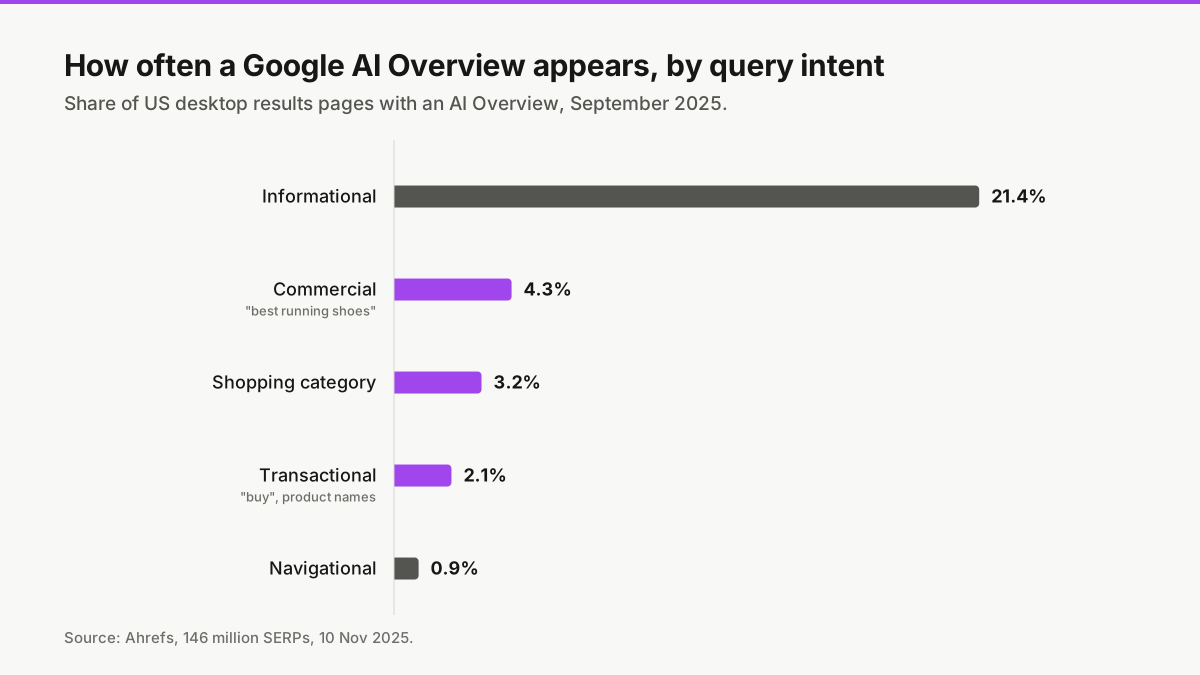
This is where the retail picture diverges from the publisher picture. Ahrefs sampled 146 million US desktop results pages in September 2025 and recorded how often an AI Overview appeared by intent.
| Query intent | Share of results pages with an AI Overview |
|---|---|
| Informational | 21.4% |
| Commercial ("best running shoes") | 4.3% |
| Shopping category | 3.2% |
| Transactional ("buy", product names) | 2.1% |
| Navigational | 0.9% |
Seer's 2026 client data, on a different sample, has the same shape: 36% of informational queries, 8% of commercial, 5% of transactional. Where the studies disagree is on research-stage prompts ("which is better, X or Y"), where Peec found AI Overviews on 87% of buying-intent prompts in April 2026 and Presenc found 38% of comparison queries. The spread is the sample: head-term product queries almost never trigger one, comparison questions usually do.
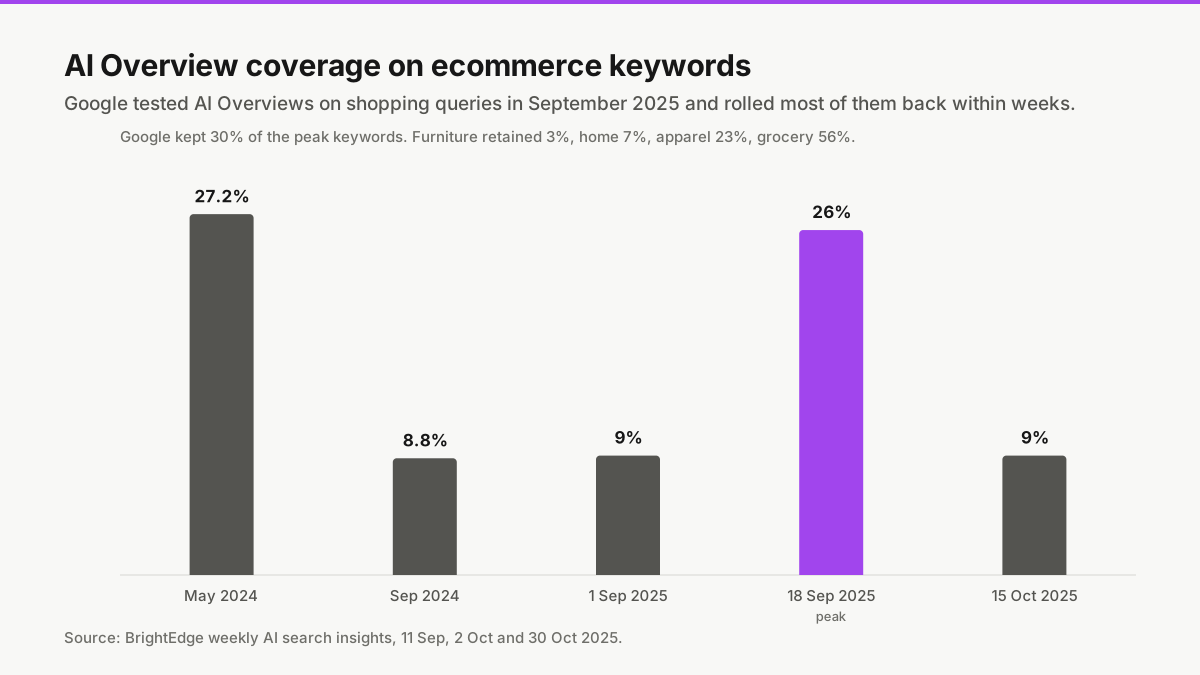
Google has tested the boundary. BrightEdge tracked thousands of ecommerce keywords through the autumn of 2025 and watched AI Overview coverage go from 9% on 1 September to 26% on 18 September and back to 9% by mid October. Google kept 30% of the peak keywords. Furniture retained 3%, home 7%, apparel 23%, grocery 56%. The queries removed were the transactional ones: "buy", price, deals and product names.
Google's own commercial-intent study, published by Semrush in July 2026, shows the same split continuing: AI Overviews on commercial queries grew 71% between November 2025 and April 2026, while on transactional queries they fell 5%.
3. What a store actually loses
Put the prevalence and the click loss together per intent and you get an expected loss for each kind of query. The click loss by intent comes from Advanced Web Ranking's July 2026 position 1 data (commercial CTR 11.91% without an AIO vs 3.51% with, transactional 10.38% vs 7.80%) and Ahrefs' 58% for informational.
| Intent | AIO prevalence | CTR loss when present | Expected click loss |
|---|---|---|---|
| Transactional | 2.1% | 25% | 0.5% |
| Commercial | 4.3% | 71% | 3.0% |
| Informational | 21.4% | 58% | 12.4% |
Now weight by where a product store's organic clicks come from. A typical DTC store gets most of its organic clicks from product and brand queries, a quarter from "best X" style commercial queries, and a slice from blog content. Using 60 / 25 / 15:
| Scenario | Weighted organic click loss |
|---|---|
| Ahrefs prevalence, AWR click loss | 2.9% |
| Seer prevalence (36% / 8% / 5%), Seer transactional loss (48%) | 6.0% |
| A publisher: 100% informational, experiment's 42% prevalence and 38% loss | 16% |
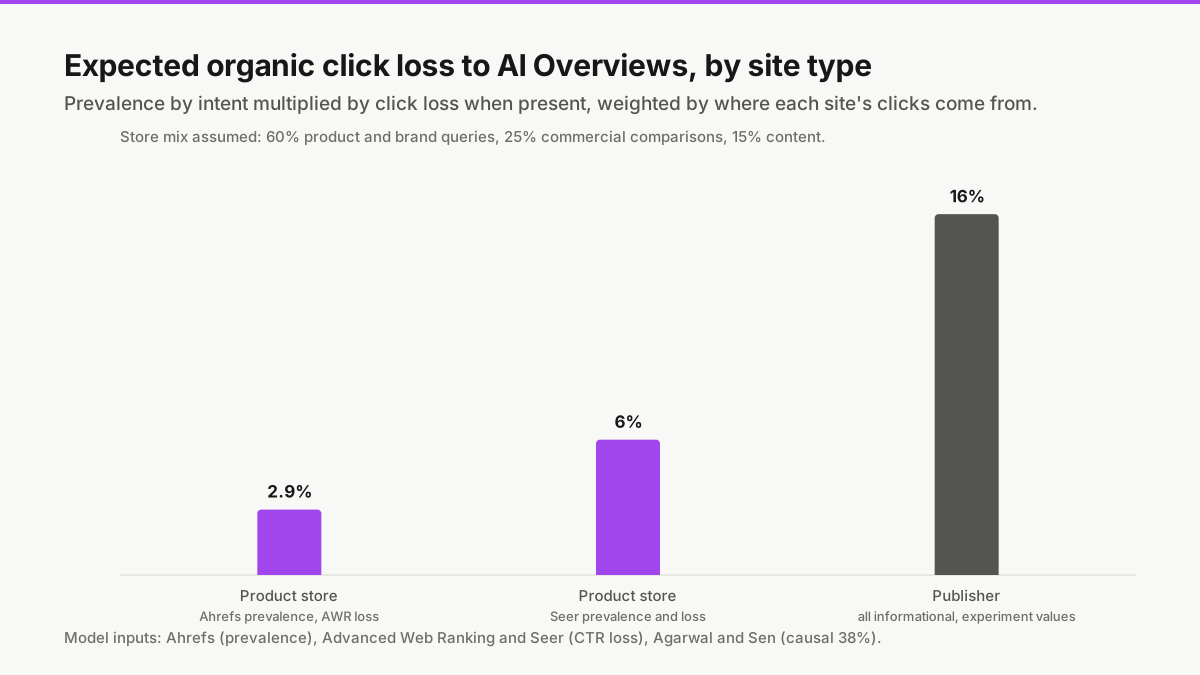
So a product store should expect to have lost somewhere between 3% and 6% of its organic clicks to AI Overviews, concentrated in its content and comparison pages, and almost nothing on its product pages. That is a real cost. It is not the 40% that publishers are reporting, and a store that cuts its content budget in response to publisher numbers is solving the wrong problem.
Two caveats. First, being cited inside an AI Overview helps but does not restore the click: Seer found that a cited brand gets 120% more clicks per impression than an uncited one, yet still 38% fewer than on a results page with no AI Overview at all. Second, the model excludes paid search, where Seer measured CTR on AIO queries falling from 19.7% to 6.3% over 15 months. If your "best X" queries are bought rather than earned, the loss is larger.
4. Where the shopping click went
The decline in search clicks has a counterpart that is easy to miss because it happens on a different surface.
AI Mode, Google's full conversational search, had over 1 billion monthly users by May 2026 and received 0.34% of US Google searches between January and April. It is a zero-click surface in general: Semrush measured that only 6 to 8% of AI Mode sessions ever visited an external site. But Kevin Indig's review of ten AI Mode studies records one exception, and it is the one that matters here: shopping prompts "produced clicks nearly 100% of the time," against 77.6% of all task sessions producing no external visit at all.
The same pattern holds in ChatGPT. Shopify reported that half of AI-referred sessions land directly on a product page, 2.5x the rate for traditional search, and that AI-referred traffic to its stores tripled year over year in Q2 2026 while traditional search sessions stayed around a third of the total. Adobe measured AI referrals to US retail sites up 62% year over year in July 2026, converting 60% better than other channels.
Put the two surfaces together and the shopping journey looks like this. The research happens inside the AI answer, where the brand is mentioned or it is not. The comparison happens there too. Then, unlike almost every other kind of query, the shopper clicks out, usually straight to one product page, and converts at a higher rate than a search visitor because the decision is already made.
That is not a loss of the click. It is a move of the decision to a place the store cannot see.
What to measure instead
- Split your organic report by intent. Product and brand queries, commercial comparisons, and content. The AI Overview loss sits almost entirely in the last two, and that is where to look before concluding anything.
- Stop counting "how often am I cited" as the goal. A citation recovers less than half the lost clicks. The question is whether the product page the assistant lands the shopper on answers the question they asked.
- Measure the AI surface directly. Ask the assistants your customers use the twenty questions a real shopper would ask, and record what they say about your products and which page they send people to. Product Gale's scan does exactly that, with the trace.
- Then tag the arrivals. Those product-page landings from AI Mode and ChatGPT often carry no referrer. Counting them at the edge is the only way the 3x growth shows up in your numbers as anything other than "Direct."
Sources
- Pew Research Center, Google users are less likely to click when an AI summary appears, 22 Jul 2025: pewresearch.org
- Agarwal and Sen, randomized field study of AI Overviews, via Search Engine Journal, 27 Apr 2026: searchenginejournal.com
- SparkToro with Similarweb, less than one third of Google searches send a click, 9 Jun 2026: sparktoro.com; Similarweb, zero-click marketing, 10 Jun 2026: aisearch.similarweb.com
- Ahrefs, AI Overviews reduce clicks, update, 4 Feb 2026: ahrefs.com; AI Overview triggers by intent, 10 Nov 2025: ahrefs.com
- Seer Interactive, AIO impact on CTR, 2026 update, 24 Apr 2026: seerinteractive.com; September 2025 update, 4 Nov 2025: seerinteractive.com
- Advanced Web Ranking, organic CTR study, Sep 2026: advancedwebranking.com
- BrightEdge, Google's holiday shopping AI Overview test, 30 Oct 2025: brightedge.com; intent hierarchy, 11 Sep 2025: brightedge.com
- Semrush, AI Overviews on commercial searches, 2 Jul 2026: semrush.com; AI Mode SEO impact, 30 Jul 2025: semrush.com
- Peec AI, 500,000 prompts, 28 May 2026: peec.ai
- Kevin Indig, the impact of AI Mode on SEO, ten studies, 21 Oct 2025: searchenginejournal.com
- Google I/O 2026 keynote, 19 May 2026: blog.google
- Chartbeat publisher data via Search Engine Journal, 24 Sep 2026: searchenginejournal.com
- TechCrunch on Shopify Q2 2026, 5 Aug 2026: techcrunch.com
- Digital Commerce 360 on Adobe's July 2026 AI referral data, 19 Aug 2026: digitalcommerce360.com
Keep reading
AI Referrals Went From the Worst Retail Channel to the Best in Twelve Months. Here Is the Full Series.
Adobe has published AI referral data for US retail every quarter since late 2024. Lined up end to end, the series shows a channel that grew 14x, flipped from converting 38% worse to 60% better, and is still mostly invisible to the stores receiving it.
Bots Passed Humans This Year. Here Is What the AI Ones Actually Do on a Store.
Cloudflare, Akamai, Fastly, HUMAN and DataDome all published edge data on AI bots in 2026. Put together, the numbers show retail absorbing nearly half of all AI bot traffic, agents spending 77% of their time on product and search pages, and Shopify's own reports hiding the whole thing.